

Two bits of good news: the Serbian government has tracked down and arrested Radovan Karadzic, the psychiatrist and poet who appears to have masterminded genocide during the last Balkan wars, and crime in Canada appears to have dropped to levels not seen in 30 years. Both are surprises in a way, and restore one’s hope about the state of the world.
Last May shortly before parliamentary elections in Serbia we heard Vladimir Jovic comment on a film by David Homel, Is My Story Hurting You? Dr. Jovic is at the center of the film, which focuses on his work with people haunted by the civil war and its aftermath in Belgrade. He was quite pessimistic about what the elections’ outcome would be because he feared that ultranationalists would win and the cycle of hate would revive. But that did not come about, and now the new government has swooped down and captured Karadzic who was hiding in plain site. Commentators are citing this arrest as a clear sign that those in power in Serbia now do not want to slip back into violence.
The news about crime in Canada is not really news to anyone who’s been paying attention: a string of Statistics Canada reports have repeatedly shown that all sorts of crime have been declining for years. To watch the television news, read many newspapers, or listen to Prime Minister Steven Harper, however, you’d think that it was the other way around. Jeffrey Simpson in The Globe and Mail Wednesday had a fine comment on that. “People hate crime, but the media love it,” he writes. “Crime is bad, and bad news sells…Politicians fear crime, not because they'll be victims themselves but because they dare not explain crime sensibly. It's any politician's nightmare to face a victim and utter anything other than a promise to be ‘tough on crime.’
“Why are crime rates falling?” he asks. “Now there's a fit subject for media inquiry, although exploring it would be more difficult (and less sexy) than reporting crimes, covering lurid trials or fulminating against the latest outrage. Can you imagine a local television newscast (the kind that follows the maxim ‘If it bleeds, it leads’) starting the news with a story about why crime rates are falling?”
The real news, as almost always, is hard to uncover since it may lie in quiet, safe streets—or on a streetcar in the middle of a busy city, which is where Karadzic was arrested. It takes determination and, sometimes, courage to find it or make it.
Thursday, 24 July 2008


Wednesday, 23 July 2008
CBC and Radio Canada Changes: All-Classic Stations Still More Popular, But Elin's on Espace Musique
The latest BBM market ratings are out, and efforts by the CBC and Radio Canada to change programming haven’t resulted in a huge surge in listeners. You’ll remember that both networks have cut the classical music content of their offerings on Radio Two and Espace Musique over the last little while, and added more “diverse” music in an attempt to appeal to a younger demographic.
In Montreal, the new statistics—measuring the period between April 14 and June 8, 2008—show the dedicated, non-public classical music station CJPX holding about steady with 4.3 per cent market share among Francophones. Its share was 4.4 during the last reporting period, and 3.5 the period before that. CBFX, Espace Musique, on the other had, held steady at 3.2.
In Toronto, where all classic CFMZ competes with Radio Two’s CBL-FM, the former still draws a larger audience (with 4 percent), although Radio Two did go up from 1.9 to 3.0 over the last two periods. Just who is listening to the stations isn’t clear from those BBM statistics that are available for free.
We’ll be listening to Espace Musique tonight (July 23, 2008) for sure, though. A concert Elin played in last Friday at the Centre d’arts Orford summer festival will be broadcast at 8 p.m. Called The Chronicles of Anna Magdalena Bach it features the music Johann Sebastian Bach wrote for his second wife. Soprano Kimy McLaren is accompanied by Martin Robidoux on the harpsichord and Elin on viola da gamba. If you’re interested, you’ll be able to find the concert on the net at 8 p.m. Eastern Daylight Time too.
Tuesday, 22 July 2008
Green City: When the Best Lawn Blooms Dark Pink Sometimes
 Yesterday morning the gardeners were mowing lawns in the cemeteries on Mount Royal. Armed with weed whackers to get around tombstones and sit-down power mowers for the more open areas, they were cutting back the grass which has grown fantastically this summer. Good rains every five or six days, plus much ground moisture from last winter’s heavy snow fall, have meant luxurious green all over the northern and western slopes of the hill that is called a mountain around here.
The lawns are not sterile, grass-only ones, however. Over the decades they’ve become lovely patchworks where clover, daisies, violets, wild strawberries and other flowering plants mixed in with the more traditional grasses. Probably the most spectacular are the stretches of what I think is a hybrid of creeping bush clover (Lespedeza repens) which are in bloom now, turning the greensward into a carpet of dark pink.
Last week’s New Yorker (the one with that awful Obama-as-terrorist cover) has an interesting article by Elizabeth Kolbert, reviewing several books about lawns. The perfectly manicured suburban lawn is a wasteful conceit we can not afford to maintain, she seems to be saying. If she saw the spectacle the clover is providing now, she’d cheer, I imagine.
For more about lawns and how the desire for them has fueled sprawl, check out my Green City: People, Nature and Urban Places, by the way.
Note: Originally I thought the patches were of alpine azalea but a closer look suggets that they are of a creeping clover. Lespedeza repens is not supposed to be found in Quebec according to The Audubon Society Field Guide to North American Wildfloers, Eastern Region. The handbook does say that the plant hybridizes widely, though, so perhaps that's what has happened. Or maybe its success on Mount Royal says something about climate change.
Monday, 21 July 2008
The Best Love Stories; Some Suggestions for Good Summer Reading
One of the most interesting things about having a blog is seeing who reads it, and how they find it. Lately my counter suggests that a lot of people are looking for love stories to read this summer: a Google search for “best love story” brings up my post from last spring about The Extraordinary Garden by François Gravel which I still think is one of the best love stories I’ve ever read. Certainly it’s tops in the category: love between adults who realize that the world doesn’t revolve around them.
But what else is there which might be recommended to people who like a good romantic tale for summer reading? Here are a few suggestions:
Forbidden love: Arundhati Roy's The God of Small Things A tale of love between two people who shouldn’t care for each other for many, many reasons of social class and personal history
Love which finally finds its place: A Suitable Boy by Vikram Seth, an epoch story of India, which could have taken place many other places.
Unrequited love: Clara Callan by Richard B. Wright. Small town girl holds a torch for a city man for decades
Comic love: Moo by Jane Smiley A big, sprawling satiric look at a university town and the people who live and love in it. It ends, as all good comedies do, with weddings.
Young love that ends well: Hunting and Gathering by Anna Gavalda Translated from French, this novel shows young people searching for their destiny and finally finding it. Funny and profound.
Love after high school. My own After Surfing Ocean Beach, which started out to be my “high school” book: I went to Point Loma High School in San Diego and spent far too much time hanging out at Ocean Beach. But the more I got involved in the story, the more I realized that what really mattered about the characters was what happened to them afterwards—how they played the hands they were dealt, and how they ended up loving or not loving.
Good reading. The books should all be available at good independent booksellers across North America, or through Amazon.ca .
Saturday, 19 July 2008
Saturday Photo: Traces of the Sacred at Chartres and at the Pompidou
 Christian Rioux last week had an interesting review of an exhibit at the Centre Pompidou in Paris called Traces of the Sacred. The museum is a fascinating structure in the heart of Paris featuring art of the 20th and 21st century. We spent two afternoons there on our trip, Lee to commune with his favourite mid-20th century works, and I to try to make sense of this exhibit.
It begins in the late 19th century and the end of conventional European understanding of Chrisitianity--"God is dead," as Nietszche said. Then it examines the works of art which grew from a search for new forms of spirituality. Some of what is on display is undeniably wonderful: a lucite block containing bubbles and called "Alternate Universe" for example. But a lot seems forced, diluted or simply incomplete, inspired by misreadings of other belief systems.
Compare that with the spiritual impulse behind Gothic cathedrals and even I, thorough-going unbeliever that I am, stand in awe of what was created in the past.
And what is still believed in by many people, it seems. By the end of the day, hundreds of votive candles were burning in every cathedral we visited.
Friday, 18 July 2008
Holidays for Construction Workers--and a Whole Lot of Other People--in Quebec.
Workers all over Quebec will down tools at noon today—not in protest but for pleasure. The “Construction Holiday” begins then and will run until Monday August 4. The two week period began as a mandated halt for the building trades in 1971, but many other industries also shut down to avoid conflict within families. In all about quarter of the work force will be off.
Anyone who works in Quebec has two per cent of his or her pay deducted every pay period, to be matched by a similar contribution from the employer. This has to be paid out once a year, creating the equivalent of a two week’s pay, but you can collect anytime, including if you quit your job.
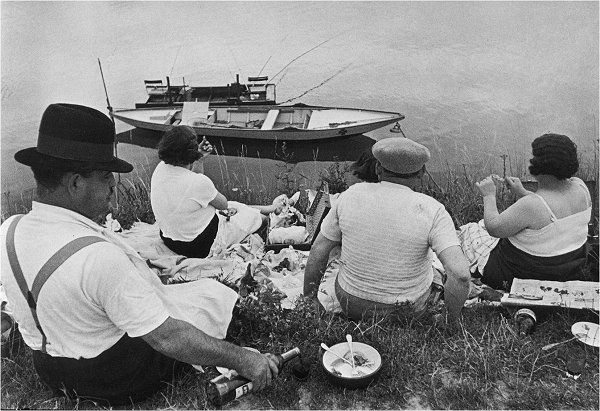 This always reminds me of one of my favourite Henri Cartier-Bresson photos. Called "On the Banks of the Marne," it was taken in 1938, two years after the French government mandated a somewhat similar universal holiday period. One of the reasons for the program was to spread work around during the tough economic times of the 1930s, but obviously holidays meet deep needs.
But don’t expect to find all construction work stopped in Quebec. Road construction continues since it has to be done during good weather. Those sites shut down in the dead of winter.
What a climate!
Photo: Afterimage Gallery
Anyone who works in Quebec has two per cent of his or her pay deducted every pay period, to be matched by a similar contribution from the employer. This has to be paid out once a year, creating the equivalent of a two week’s pay, but you can collect anytime, including if you quit your job.
This always reminds me of one of my favourite Henri Cartier-Bresson photos. Called "On the Banks of the Marne," it was taken in 1938, two years after the French government mandated a somewhat similar universal holiday period. One of the reasons for the program was to spread work around during the tough economic times of the 1930s, but obviously holidays meet deep needs.But don’t expect to find all construction work stopped in Quebec. Road construction continues since it has to be done during good weather. Those sites shut down in the dead of winter.
What a climate!
Photo: Afterimage Gallery
Thursday, 17 July 2008
Iran and Lee's Smile: When Seeing Shouldn't Be Believing
A week ago Iran tested some missiles, causing quite a storm of comment. Not the least concerned of it swirled abour the question of how many missiles there were. A video posted last Wednesday, the day of the test, clearly shows four missiles launchers but only three successfully firing. Shortly thereafter Iran released a still picture which apparently had been Photoshopped to show all four firing. Then, while discussion flared in cyberspace, they re-released an un-doctored photo of three missiles which matches the video.
Seeing isn’t believing, in other words, a maxim we should all take to heart, particularly when so many agendas are at play.
But the incident also reminded me of a little judicious cropping I did for our Christmas letter and blog last December.
For some reason Lee rarely smiles in photos, but I wanted one with him looking pleased so I took a picture from Lukas’s and Sophie’s wedding and used only his head and mine. The whole picture shows him making a devil sign behind Lukas’s head in the true Soderstrom horsing-around tradition, but you’d never know it from our Christmas messages.
If you’d like to see what Lee looks like now, here’s the link to the McGill Economics Department website which featured his picture the week after he officially retired. But now, come to think of it, his face isn't as broad as that. Could this shot be doctored a bit too and stretched to fit the shape of their template? Beware what your eyes see!
Note: thanks to Kris Down who took the picture.
Seeing isn’t believing, in other words, a maxim we should all take to heart, particularly when so many agendas are at play.

But the incident also reminded me of a little judicious cropping I did for our Christmas letter and blog last December.
For some reason Lee rarely smiles in photos, but I wanted one with him looking pleased so I took a picture from Lukas’s and Sophie’s wedding and used only his head and mine. The whole picture shows him making a devil sign behind Lukas’s head in the true Soderstrom horsing-around tradition, but you’d never know it from our Christmas messages.

If you’d like to see what Lee looks like now, here’s the link to the McGill Economics Department website which featured his picture the week after he officially retired. But now, come to think of it, his face isn't as broad as that. Could this shot be doctored a bit too and stretched to fit the shape of their template? Beware what your eyes see!
Note: thanks to Kris Down who took the picture.
Wednesday, 16 July 2008
Hops or Hay? Are Mortgage Guarantees Worth Only Six Times Beer?
Notes on finances: So the U.S .government is going to support Fannie Mae and Freddie Mac, the institutions which insure about half the mortgages on housing the country, to the tune of $300 billiion? As Paul Krugman points out, they had nothing to do with the subprime mortgage mess because by definition the mortgages they insure meet very strict requirements. Nevertheless they are caught up in the storm. They “can’t be allowed to fail. With the collapse of subprime lending, they’re now more central than ever to the housing market, and the economy as a whole.”
Three hundred billion dollars ain’t hay, for sure. But its relative size should be measured against another figure tossed around last week: the $52 billion InBev, the Belgian-Brazilian brewer, is going to pay for Anheuser-Busch which controls nearly half the market for beer in the U.S. Does that mean that the health of Fannie Mae and Freddie Mac—two pillars of the economy—is worth less than six times a major beermaker?
Elin had 60 Budweiser boxes full of stuff when she moved recently, and beer is the classic thing one offers friends who help one move. But good housing should be valued a lot more highly than 33.3 billion six packs (at $9 US a six pack,) I think.
How much hops would that take, BTW? And what's the futures market for them?
Tuesday, 15 July 2008
Literacy Programs, Building Schools and Omar Khadir: How to Make a Change in the World, and How Not To
Sophie is back from a conference on literacy interventions and reading problems in Halifax. She and her boss gave a presentation on some very effective techniques being used in primary grades in the Lester B. Pearson School Board here. It went well, it seems. Good, because learning to read is about the most important thing a person can learn to do.
In Sunday’s New York Times, Nicolas Kristof expounded along those lines in a column, “It Takes a School, Not Missiles.” In it he shines a spotlight on Greg Mortensen who has been building schools in Afghanistan and Pakistan with the help of locals since 2003. “Schools are a much more effective bang for the buck than missiles or chasing some Taliban around the country,” Kristof quotes Mortenson, a U.S. Army veteran.
Kristof goes on: ’“I am convinced that the long-term solution to terrorism in general, and Afghanistan specifically, is education,” Lt. Col. Christopher Kolenda, who works on the Afghan front lines, said in an e-mail in which he raved about Mr. Mortenson’s work. “The conflict here will not be won with bombs but with books. ... The thirst for education here is palpable.”’
Compare that with the videos released this morning of child soldier Omar Khadir, a Canadian citizen still in jail in Guantanamo. He has been charged with killing a U.S. soldier in Afghanistan when he was 15. It appears that for the last six years he has been held in solitary confinement and subjected to very harsh treatment. Nothing educational has gone on in that time—except make a misled boy in a very troubled young man. What would have happened if he'd dedicated teachers like Sophie, or a chance to help build school?
Monday, 14 July 2008
Windows on the World: More about Books and What Stephen Harper Should Be Reading
Friday the topic was the value of fiction-reading and how it expands your worlds, giving you experiences that you might never have otherwise. I imagine Yann Martel would agree about the importance of that aspect of reading novels and short stories. Almost without exception, the books he has been sending every two weeks to Prime Minister Stephen Harper for more than a year have been fiction. Martel’s stated aim is to provide some “stillness” in the PM’s life, to suggest some reading that will enrich the PM’s understanding and give him some pleasure. In the letters accompanying each book, Martel gives the reasons for his choice, and frequently he cites the windows the books offer into other ways of thinking and living, which is just what the University of Toronto researchers suggest is so valuable about fiction reading.
Martel’s most recent gift is Thomson Highway’s play The Rez Sisters, about which Martel says: “It's a comedy, the kind that makes you laugh while also delivering a fair load of sadness. Stereotypes are typified and then mocked, but it's not an overtly political play, hence its universal resonance.”
Two weeks before, Martel sent Harper the graphic novel Persepolis by Marjane Satrapi. “People in Iran are like people anywhere,” Martel wrote. “(T)hey want to be happy and live in peace, with a modicum of material well being. The rules of their society, their values—the means by which they hope to become happy—are different from Canada’s—but what of that? They have their problems, we have ours. Let them muddle through theirs, as we hope to muddle through ours.”
Martel says that in Persepolis he recognized the Iran he found several years when traveling there with a friend. “Such eye-opening travel as I had the luck of doing isn’t a possibility for everyone…Which is where books come in. The armchair traveler can be as well-informed as the backpacker roughing it, so long as he or she reads the right books,”
Ah yes, the right books. There are so many of them. Would that Stephen Harper have time to read some.
Saturday, 12 July 2008
Saturday Photo: Daylilies for a Summer Day
 Two things arrive in July here marking the beginning of high summer: daylilies and cicadas. When I was out walking this morning I heard the sharp, metallic buzzing of the bugs, and all along my path I saw daylilies in bloom or ready to bloom.
The flowers are among my favourites, and I've come to associate the strange, un-animal sound of the cicadas with good times too.
The first time we heard them was a different matter, however. That was many, many years ago when we drove across the continent for the first time as we moved to Montreal. Within 50 miles in eastern Wyoming and western Iowa we dropped down from the dry Colorado Plateau into the much more humid basin of the Missouri-Mississippi basin. Suddenly we heard a terrible racket and Lee, who was driving our VW Beetle, pulled over on the roadside to see what was wrong with the car. But the noise did not stop when the car's engine stopped. It was at that point that we began to see what differences climate zones make.
Daylilies--which I don't remember blooming in such profusion on the West Coast--were much easier to get used to.
Friday, 11 July 2008
Fiction--Real or Unintended--Can Make Your Life Better: Tales from Cosmo and The New Scientist
My sister always read the magazine Cosmo, even after she had comfortably settled into the wife/mother/career role. “It’s written for people like me, you know,” she said. “It’s what we think about, but would never do.” A sort of fiction, in other words, that you can indulge in guiltlessly.
I was reminded of her yesterday by two stories in The Globe and Mail. The first was about a young woman who has written a book about her very positive experience following Cosmo’s advice for a year. The second—on the same page in the edition we get—had its origin in a much more serious publication, The New Scientist. A group of researchers led by the University of Toronto’s Keith Oatley has been studying the social skills of fiction readers and how reading it affects the way people interact with the world. Their conclusion: fiction readers have exceptionally strong “people skills.”
"Fiction is really about how to get around in the social world, which is not as easy as one might think," the Globe quotes Oatley. "People who read fiction give themselves quite a bit of practice in understanding that. And also, I think reading fiction sort of prompts one to think about these questions - you know, what are these people up to?"
Anyone who loves a good story understands what Oatley is talking about. Think of all those things you might never experience but came across in the pages of a novel or a short story collection. Your world is wider and your appreciation of the trials and tribulations of others is greater. You may learn a lot too, even when you’re reading quasi-fantasy like Cosmo.
Thursday, 10 July 2008
Grand Plans for Montreal: Griffintown and le Quartier de Spéctacles Raise Questions about How to Do It and How Not To
Montreal’s mayor Gérald Tremblay appeared jubilant yesterday when he helped unveil plans for the first phase a new entertainment quarter—almost as jubilant as my friend who lives in Griffintown. Their good humour comes from very different things, however.
Tremblay announced that “new symbol of Montreal's role as a great cultural centre" will be kicked off next year in time for the 30th anniversary of the Montreal Jazz Festival. It consists of a big plaza which can be used for outdoor concerts across from Place des Arts, whose five concert halls and art museum are currently the core of the district. Some might say that Tremblay’s joy is an attempt to put a good face on a difficult situation, however. Plans to add a new hall dedicated to the Montreal Symphony Orchestra—talked about since Place des Arts opened in 1963—received a shock last week. A public-private partnership has seen estimated construction costs jump from $105 million to $266 million largely because the parking garage on which the hall will be built must be reinforced, Le Devoir reported.
My friend’s enthusiasm stems from some news which might also make Tremblay frown. He rents a loft in a building that is supposed to be expropriated to make way for massive redevelopment of the former industrial area down the hill and about two kilometers away from Place de Arts. Eviction notices were supposed to be sent out last month, but he and his fellow tenants have received nothing. “The developer is having trouble getting financing together,” he crowed. “Maybe it’s not going to fly after all.”
His take on the situation was partially corroborated by another story in Le Devoir saying that the city will put off sending eviction notices until September: before then Devimco, the developer, must present the city with guarantees for the $65 million needed to pay for the expropriated property. The money is there, Devimco told Le Devoir, although the newspaper notes that architects have not yet been hired either.
The development of the entertainment district—le Quartier de spéctacles—and of Griffintown are both examples of thinking big about how a city should evolve. A great deal can be said for grand plans when it comes to installations that will be used by many. Place des Arts has been a big, popular success: its plaza welcomes crowds of a couple of hundred thousand regularly for outdoor events while its halls are constantly full. Adding to that is an appropriate exercise of city leadership and resources.
Grand plans like the Griffintown one are much more questionable. If Devimco’s plans fall apart and the area is allowed to redevelop at a slower pace as it had begun to do, the city would be a lot better off.
This is a classic Baron Haussmann-Jane Jacobs confrontation, and I’ll write more about that later.
Wednesday, 9 July 2008
The End of the Automobile Age? Wouldn't That Be Something?
Teenagers are driving less, The New York Times says. La Presse reports that public transit use in the Montreal region is rising considerably. And, let me tell you, after a day spent in the car, I’d think a long time before I moved any place where I was dependent on the automobile only.
Not only is the price of gas skyrocketing--$1.49 a litre yesterday morning or something like $6 US a US gallon—but driving from place to place is such a drag. Yesterday was the day to stock up on all the groceries that are heavy or bulky, there were a dozen books to borrow from the McGill Library, and I’d been promising Lee to get a flat of Quebec strawberries which are at their best right now. It was very hot, traffic was snarled because of road repairs everywhere: in short it was not my best day…
The summer before I turned 16 I got my first driver’s license: because of a quickly-closed loop hole in the regulations if you took a driver’s ed course, you could get your license immediately, which is exactly what I did. Lee didn’t ask me out even though we’d been friends for months until he had a car to take me some place. When we got married he assumed at first that we’d have two cars, as his parents did.
Our kids, however, have grown up in a different world. Lukas, at 28 still doesn’t have a license, and Elin didn’t get hers until she was 26 even though she plays a cello-sized instrument and has to schlep it around all the time. There are times when I think they are a lot smarter than we were.
But we learned so I guess there’s hope for everyone.
Tuesday, 8 July 2008
NDP Recruits Great Candidate for Westmount-Ville Marie By Election: CBC's Loss Is Public Policy's Gain
So it’s official: Anne Lagacé Dowson, host of CBC’s Radio Noon show in Montreal, will be running for the NDP in the Westmount-Ville Marie riding by election later this summer. This is very good news. Not only is Dowson an intelligent, charming, hard-working woman, she’s at the right place at the right time. This will be a campaign to watch, and one I’m hoping to be involved with in some small way.
Of course, there’s an irony here.
My novel The Violets of Usambara has its roots in part in my involvement in the NDP in the 1980s. At the time I was sure that the NDP could win my home riding of Outremont, and with Thomas Mulcair it did in a by election last fall. Now with another strong candidate perhaps it will be able to convince voters in a riding which is much more diverse than its name indicates to send a strong message in favour of things like peace-keeping, sensible economic policy, and the importance of strong cities in saving the planet.
But because Ms. Dowson had to take a leave of absence as soon as she told the CBC she was running, an interview she had scheduled with me last week about Violets had to be cancelled. Maybe it will be rescheduled, but maybe not. As I told my husband when Radio Noon told me about the change in plans, here’s some good news and some bad.
On balance, though, in the grand scheme of things, I should remember what Humphrey Bogart said to Ingrid Bergman in Casablanca: “the problems of (a couple of) little people don't amount to a hill of beans in this crazy world.”
Here’s looking at you, kid! Lots of luck and bon succès, Anne.
Monday, 7 July 2008
Domestic Interlude: When Some Things Just Have to Be Done
Hot today, but a number of things have to be done. Like wash windows, a job I’ve been putting off for weeks.
One of the nice things about living in a climate with dramatically different seasons is that for a good part of the year some of the tasks that life involves disappear. There is no snow shoveling from April to October around here, and you can’t do much lawn mowing from October to May, for example. You can wash the inside of windows for part of the winter, and I find that I am driven to do so at least a couple of times when it’s warm enough so that cleaning solution won’t freeze on the panes.
The outsides are something different, thank goodness. Professional window washers make the rounds of the shops all winter long: I’m not sure what they use but it doesn’t seem to freeze quickly. At home, though, I take the cold weather as a good reason to forget about the outside. But I have had no excuse for a good long time, so I should go do something domestic before I get back to deciding what my next non-domestic project should be…
The big question is: what do use to wash them? I've always used ammonia and water, wiped off with sheets of newspaper, but the buzz is that ammonia is an environmental no-no. Vinegar and water is supposed to be good, but it clogged up my spray bottle the last time I used it. I found a number of suggestions at an answer pool site. Maybe I ought to do a comparison like the one I keep thinking I ought to do with dishers and washing dishes by hand.
No, it's too hot to think about that. To work! And then to sit under the fan.
Saturday, 5 July 2008
Saturday Photo: When Walking Gets Too Much and You Need a Little Help...

The world is on holiday this month--or so it seems--and there are going to be many people over the next few days who might wish to have what this man appears to have--three feet!
Actually of course what we see is two boots and one foot, as in the famous picture by Bruegel, The Peasant Wedding.
My photo was taken in Paris, but the need for a little pedestrian aid can occur anywhere. Or any time: the painting dates from 1568.

Friday, 4 July 2008
Fireworks in San Diego, Quebec City and, perhaps, Iraq
The Fourth of July is the day when my father would be reluctantly persuaded to drive us to the edge of a cliff overlooking Mission Bay in San Diego so we could see the celebatory fireworks in the distance. He hated crowds so he would never take us to the amusement park where the pyrotechnics were set off so we could see them up close. When Montreal began to have a fireworks competition at the old Expo 67 amusement park in the middle of the St. Lawrence, I began to understand his reluctance better. We took the kids once, which meant huge crowds on the Jacques Cartier bridge which overlooks the display. Since then the fireworks have become almost routine, with regular displays in addition to the 10 summer shows.
But last night Quebec City saw the grand-daddy (or perhaps, le grandpapa) of pyrotechnic shows. Some 7500 individual items--supposedly the largest number in Canadian history--were set off from barges in the St. Lawrence while hundreds of thousands watched from the shore and the bridges. Shipping was stopped on the St. Lawrence for the first time in the summer since Quebec City was founded. And the founding of the city is of course what the celebration was all about: the 400th anniversary of the arrival of Samuel de Champlain on July 3, 1608.
A lot of water has flowed down the St. Lawrence since then. Empires have risen and fallen, a fact that is good to remember during patriotic celebrations. Quebec City had been existence nearly 170 years when the Declaration of Independence was signed, while there had been great cities on the shores of the Euphrates a good 3,000 years.
What kind of fireworks will there be in Baghdad today?
Thursday, 3 July 2008
Growing Like Weeds: The Answer to Green House Gases?
My neighbor is back in the city for a few days after passing some time at her cottage in the Laurentians. Things are incredibly green, she says, and growing like…well, growing like weeds. The immense amount of snow last winter plus frequent rain in late spring have combined to make this a bumper year for all sorts of plants.
Vigorously growing plants: therein lies a partial solution to the problem of green house gases, two recent articles suggest. The first, by Freeman Dyson in The New York Review of Books, notes that carbon in the atmosphere decreases during the growing season in the northern hemisphere. After discussing two new books dealing with global warming—one which argues that the long turn costs of doing nothing will equal the costs of several possible solutions—Dyson suggests that trees bred or genetically modified to take up carbon rapidly might effectively counteract what we’ve been doing to the atmosphere.
Then Sunday’s New York Times Magazine had a fascinating article about weeds by Tom Christopher, “Can Weeds Help Solve the Climate Crisis?” The scenario is pretty gloomy, looked at one way, because it appears that many weeds grow more vigorously as the carbon dioxide content of the air increases. Christopher says that kudzu is moving north and taking over more forests; ailanthus trees next to a major highway grow 20 feet in five years compared to five feet in the mountains; and if you make things tougher, the fittest weeds will thrive.
But this can be worked to our advantage. Specifically Christopher quotes weed expert Lewis Ziska arguing that kudzu roots could be a good source of ethanol, while the vines could be burned. But there are other possibilities. Christopher writes: “If we are to avoid disaster, experts agree, we will need to be tenacious but flexible, ready to identify and exploit any opportunity in what will be a challenging, even hostile situation. In this new world that we have made, weeds, our old adversaries, could be not only tools but mentors.”
One way to look at human history is continual destruction of forests. The Indian epic Rig Veda talks of a great forest which extended from the Indus to the Ganges; the Cedars of Lebanon were chopped down in part to build Babylon; Julius Caesar’s Europe was covered with forest; and the island of Madeira got its name because of its trees, which burned in a forest fire which lasted seven years in the 1420s. The deforestation of North America followed, and we now seem intent of finishing the job in Amazonia, Southeast Asia and elsewhere.
So there certainly is room for reforestation. Would doing this mean developing Dyson’s super trees? Or could we rely on weed trees to do the job? I have no idea, but it is time that some serious research was done on the subject.
Wednesday, 2 July 2008
African Solutions for African Problems: Good News from Burundi, Bad News from Zimbabwe
Ten days before Robert Mugabe “won” the presidential election in Zimbabwe, the last remaining rebel leader in Burundi announced the end of their struggle against a government of reconciliation. According the United Nations information service IRIN, Agathon Rwasa, marked the formal start of the cantonment of his fighters at a special ceremony.
"Through this pre-cantonment process we want to show the Burundian and international community that we are committed to reaching a lasting peace," Rwasa said as 150 combatants from his Palipehutu-Forces nationales de libération (FNL) assembled at Rugazi.
This is good news: the slow march toward peace in Rwanda’s non-identical twin has been going on for nearly a decade. That was when African nations set in place an embargo against Burundi in an attempt to bring the warring Tutsi and Hutu factions to the negotiation table. Nelson Mandela played a decisive role in those discussions, which led to relatively free elections and the implementation of a government of reconciliation three years ago.
African Union leaders meeting this week have not come down with similar sanctions against Zimbabwe. Unlike Mandela, whose continual efforts to bring democracy and peace to his part of the world were so important in Burundi, South Africa’s current president Thabo Mbeki has dragged his feet. According to the Christian Science Monitor, this is nothing new with Mbeki.
The long, but ultimately successful struggle in Burundi is evidence of how Africans can solve their own problems when they act in concert and when their men of principle are listened to. Mandela, whose 90th birthday was exhuberantly celebrated in London last week too, should serve as an example to his succesors.
Tuesday, 1 July 2008
Moving Day and Staying Put in Montreal: July 1 in All Its Splendour
Today is Canada Day, and also Moving Day in Montreal. For most of the country it’s the holiday which celebrates the founding of the nation in 1867. There will be some festivities here too, but the biggest activity will be moving.
About 60 per cent of Montreal households are renters, a proportion which is decreasing with the increased availability of condos. Still, the fact that the standard lease expires July 1 means that thousands of people move on or around that day. Our family is touched this year. The reason we took Elin to CAMMAC on Sunday was because Emmanuel is deeply involved in boxing his marvelous stuff in preparation for their move into a large duplex next Sunday. Today Lukas and Sophie are helping a friend move, and for the last week or so Lee has been clearing out his office at McGill.
That last move is involving getting rid of many things. He’s been in the same office for 38 or 39 years, and the wall hanging—an interesting piece of fabric I found for him years ago—has not been washed since Lukas was born, I’m pretty sure. We brought two car-loads of books and papers home last week, but there’s still another load which we’ll pick up sometime in the next few days. His project for today is to do more work on the bookcase extensions required for all the stuff he thinks he’ll still want to have around. Of course, all this is a way of saying that July 1 has another meaning for us this year: after 40 years at McGill, he’s officially retired as of today. For a job that he took on a three year contract back in 1968, it turned out pretty well.
Monday, 30 June 2008
Making Music in the Woods: Real Diversity at CAMMAC, But Not, Alas, at the CBC
Yesterday we delivered Elin to the CAMMAC (Canadian Amateur Musicians Musiciens Amateurs du Canada) summer music program where she’ll be teaching this next week. Part vacation colony, part summer school, CAMMAC is a unique place which welcomes families as well as adults who take their music enthusiastically but seriously. When we arrived people were pitching tents in the campground, a couple of 9 or 10 year old boys were practicing soccer moves on the lawn and a passel of younger kids were playing in a big sand box. All the while others were unloading a wide variety of musical instruments or, having arranged their rooms in the main building, were rocking on the wide porch which looks out over Lac Macdonald.
It’s an idyllic setting, with varied programs all summer. This week it’s Early Music with an emphasis on that surrounding the pilgrimage to Campostella, with activities ranging from advanced viola da gamba workshops through concerts to beginner recorder lessons. Later on there will be jazz, chamber music, and vocal weeks, during the last of which the music will range from Rossini to Broadway.
The contrast between this eclectic, joyful mix of music and what is happening at the CBC couldn’t have been stronger. The CBC brass tried to put a good spin on programming changes at Radio Two last week but, according to The Globe and Mail a Radio 2 promotional video highlights “a bevy of Canadian acts, including Jann Arden, Feist, Ron Sexsmith, Alex Cuba, Michael Bublé and rapper k-os” but only “a brief clip of a symphony orchestra in concert.”
Don’t the CBC brass realize that you don’t have to short change serious music to bring diversity to Radio Two? Canadian musicians are among the best in the world, they have a world-wide audience. But they need support at home from our public broadcaster, as the folks who are enjoying themselves at CAMMAC this summer would agree. As for the musicians who are teaching there—well, the CBC has been the incubator for many of them, and they are going to feel the Radio Two cuts acutely.
Saturday, 28 June 2008
Saturday Photo: Jane Jacobs' House in New York
 Shortly after World War II, Jane Jacobs and her husband Bob moved into a three story building at 555 Hudson in the New York's Greenwich Village. Over the next two decades, they transformed the place into a comfortable home for their family of two sons and a daughter. The bedrooms were upstairs, and the living room, dining room and kitchen were on the ground floor. By all accounts they liked the place a lot--it served as Jane's point of departure for her ground breaking book The Death and Life of Great American Cities. But at the end of the 1960s they opted to move to Toronto and Canada, in large part because of their opposition to the war in Vietnam.
Since then 555 Hudson has gone through many changes. In recent years it's been returned to retail use: for a while it was an upscale kitchen shop, and now it is home to City Crickets, an equally upscale children's store.
Next fall my book The Walkable City: From Haussmann's Boulevards to Jane Jacobs Street and Beyond will be published and right now we're lining up photos to illustrate it. The one was provided by Anne Marie of City Crickets, and we'll probably use it. Thanks a lot, Anne Marie.
Friday, 27 June 2008
When Speaking the Same Language Doesn't Mean You Speak the Same Language: Paris Match Gets It Wrong about Québec
The difference between going au Québec and à Quebec is something an Anglophone often has trouble with. That’s because the word for Quebec the province is masculine while the word for Quebec the city is feminine, and you must use a different article, depending on which you’re referring to. Au Québec, any Francophone Québécois knows immediately, refers to the province, while à Québec refers to the city which is celebrating the 400th anniversary of its founding this year.
But sometimes the French from France get confused by the linguistic subtlety, also. Paris Match, the popular French magazine (sort of a cross between People and what Life used to be) launched a special Quebec-themed issue this week. Thirty-five pages of Quebec stories and pictures, in all—but only a few references to Quebec, the city, and a lot about Montreal, the Métropole. Gilles Martin Chauffier, Paris Match’s editor in chief, admitted to Le Devoir that they’d got it wrong. The magazine’s staff had thought the anniversary was that of the first settlement in what is now the province, not the city, he said, adding that having seen the error, Paris Match, will do at least one other story on the celebrations. “You know, there have always been misunderstandings between France and Québec, and here’s another example!” he said.
Glad to know that It’s not only we imperfect bilinguals who get it wrong. Reminds me of the railroad clerk at the Gare St-Lazare who kept asking us if we’d “composté” our tickets. Around here “compost” means the same as it does in English, and we couldn’t imagine what she was talking about. Turns out she meant: get our tickets punched (probably faire ponçoinner would be North American French.) When you think about it you can see the connection: composting works best when you cut things up in little pieces, but then it was pas évident as we’d say around here.
Thursday, 26 June 2008
Getting the Message: Sprawl Costs, LEED is Cool
Maybe it’s happening. The realization that the suburban lifestyle North Americans have been pursuing for 90 years presents terrific problems, that is. Yesterday’s New York Times had an interesting story about people in the far reaches of exurbia in Colorado musing that maybe it costs too much to live in huge houses requiring constant automobile commutes.
This follows a story last week about the hottest new trophy house, the small and ecologically friendly dwelling with a LEED (Leadership in Energy and Environmental Design) platinum rating. The second story was talking houses for celebrities, who appear to be willing to pay millions to have a high LEED ratings for their houses wherever they might be built.
But unless housing in well integrated into a city it isn’t going to be very ecologically friendly, no matter how good its insulation, passive energy system and use of environmentally correct materials. That’s why the story behind Canada’s first LEED platinum house is so encouraging. Awarded last year, the distinction went to a refit of a duplex on busy Park Avenue, just a couple of blocks from where we live. Not only did Emmanuel Cosgrove and his wife recycle a lot to redo the place, it is smack dab on the middle of a big city with public transportation at the corner, a big park a block away, and shopping and recreation practically at the front door.
If there’s anything I learned while working on my next book The Walkable City: From Haussmann’s Boulevards to Jane Jacobs’ Street and Beyond it is that we are going to have to live closer together in North America and that—guess what!—it is pretty nice.
Wednesday, 25 June 2008
Good Reading Ahead: What We'll Be Discussing Next Fall
Next fall I’ll be leading five book discussion groups in libraries around Montreal, and this is the time when I’ve got to come up with lists of books to read. This is always both a daunting and a pleasant task because it's always a case of "so many books, so little time."
Thus far I've prepared the list for the Atwater Library and for the Outremont and Kirkland libraries (in French), with Pierrefonds in preparation as is the list for a smaller group in a residence for seniors sponsored by the Outremont library.
In most cases I try to include about equal numbers of male and female writers, one or more translated from the other of Canada's official language, one "classic," and at least one from a different culture. Suggestions are always welcome, but my bossiness comes out when it's time to prepare the final list. Unless I think the book will spark a really good discussion, I don't include any book I don't like. Here's the line-up for Atwater:
Wednesday, September 10
De Niro’s Game by Rawi Hage
The winner of the Impac Dublin Prize 2008
Wednesday October 8
The Golden Notebooks by Doris Lessing
Nobel laureate 2007
Wednesday, Novermber 12
A Blade of Grass by Lewis De Soto
“the taut story of two women, one white and one black, who struggle to save their farm and, ultimately, their lives.” A Heather Reisman pick
Wednesday, December 10
Kamouraska by Anne Hébert
“Generally considered her finest novel.” A murder and love story set in mid-19th century Quebec
Wednesday February 11
Hunting and Gathering by Anna Gavalda
A delightful, world-wide best seller by the young French writer
Wednesday, March 11
Moral Disorder by Margaret Atwood
Short stories (some perhaps autobiographical) by the Canadian icon,
Wednesda, April 15
The Yacoubian Building by Alaa el Aswany
Set in Cairo, the story of the residents of famous apartment block has swept the world.
Wednedsay, May 13
Falling Man by Don Delillo
Winner of the National Book Award
Wednesday, June 10
The Girl in the Tangerine Scarf by Mohja Kahf
Growing up Muslim in Indiana and much more.
Tuesday, 24 June 2008
Quebec's Fête nationale: a Party for Everybody
Today is Quebec’s Fête nationale, what formerly was called the Fête de Saint-Jean-Baptiste. That holiday had a distinctly parochial colour, being centred on celebrating the French (and Catholic) fact in Quebec. But times have changed, and the official line is that this is a holiday for everybody who lives in Quebec and who considers him- or herself a Quebecker.
I go along with the heartily, and we even fly a Quebec flag. I’ve had arguments with Anglophone neighbors who think I’ve letting down the side, but I don’t agree. I have chosen to live here, my children were born here, this is a holiday that belongs to me too.
That sprit of inclusion will show up tonight at the big public show in Parc Maisonneuve. Normand Braithwaite, whose father came from Jamaica and who is a Francophone media star, will be emcee for the show as he has been for the last five years. The artists performing include Samian from the northern part of Quebec who raps in French and Algonquin; Musa Dieng Kala, originally from Senegal; Johanne Blouin who is what is called here une Quebecoise pure laine; and Zachary Richard, the Cajun star from Louisiana.
We won’t make it (it's across town and it doesn't start until 9:30 p.m. and we're sometimes old and cranky), but the music is going to be fabulous.
Monday, 23 June 2008
Political Choices at Lunchtime: Plums from California or Bananas from Anywhere?
Another trip to the Jean Talon market this weekend. It’s about a half hour walk away, and since Saturday was a gorgeous early summer day, Lee came along to help carry the goodies home. Strawberries were the same price they were the week before--$10 for a two quart basket---but there were more of them. I saw the first flats of 12 smaller baskets, although at $24 a flat, few people were buying that many at once. The supply should increase this week in time for the Festival des fraises next weekend.
Bananas range in price from 49 to 79 cents a pound, but we didn’t buy any. They’re not a fruit I like that much, and I tend to buy them when there is nothing else available, as in April when the local apples have all gone soft and the early fruit from elsewhere on the continent hasn’t come in yet.
I may cut out buying them completely after reading “Yes, We Will Have No Bananas” by Dan Koeppel in The New York Times this week. In it he discusses the way growing the fruit and transporting it from the tropics have had nefarious political effects in the past—there are good reasons why “banana republic” is a slur—and horrendous ecological repercussions in the near future. The bananas for sale in North America are all clones of one variety developed when an earlier variety, also propagated by cloning, fell ill and died all over the world. If ever there were an object lesson about monoculture, the banana story is one.
We also bought some plums from California for lunches. They aren't as good as the ones from Ontario and the Italian prunes from around here that we'll get in August. , But at least they're trucked in, so their carbon footprint should be less than the fruit flown in from Chili that flooded the market a few weeks ago.
Saturday, 21 June 2008
Saturday Photo: Summer Field at Giverny
 One last photo from Giverny. This one is not of the garden itself, but the hillside behind it. The field--or one very similar--shows up in several of Monet's paintings, notably one of his wife and son with the poppies being just dabs of colour in the green field.
It's an appropriate photo for the first Saturday of summer too. Already the sun rose a minute later this morning than yesterday, the day of the solstice. No wonder this season was a time of celebration in pagan--and more recent--times.
Friday, 20 June 2008
Cormac McCarthy's The Road: Guys Like It Because It's Basically a Father-Son Story
Rolande came up with the best explanation for the extraordinary popularity of Cormac McCarthy’s Pulitzer prize-winning novel The Road: it portrays a tender relationship between a man and his son which is something many men lack and most men crave. Such depictions are relatively rare in fiction, and, since the context is a horrific end-of-the-world setting, liking the novel can’t be construed as liking something sentimental.
The occasion for our discussion was the last get-together of the season for the Durochères, a group of women who have been meeting once a month for more than 25 years except during July and August. Most of us were neighbors when the group began, and while several have moved, the conversations have the same intimacy you find among people who have shared an interest for a long time. This time as the discussion progressed it became clear that none of us liked the book very much, some of us were surprised that the mother in the book killed herself rather than face the lonely after-Apocalypse world, and everyone was puzzled at the extremely positive critical reaction. Our response was very similar to what my cousin Cathy reports took place in her reading group in Nevada: a couple of women found the ending hopeful, but the rest found it very hard going.
Had it not been for Rolande’s elegant analysis (and I should mention that Rolande is definitely a woman's name in French, and that she’s an artist, not a literary expert, a writer, or a psychologist) I would have been even more annoyed by the list of summer reading the morning man on Radio Canada gave this morning. The Road made his top half dozen: a master piece, he said. Here’s the link: as I write this his selections haven’t been posted yet but they should be by the end of the day:
Another indication that there are real differences between men and women that show up in the most surprising ways? I think not, because male reactions to the book show that tender feelings are there, it’s just that most men have a long way to go before they can admit to them openly. The Road may be simply a path they must take before they get there.
Thursday, 19 June 2008
Four More Books for Stephen Harper to Read: Yann Martel Continues His Campaign to Provide the PM with "Stillness" and Good Reading
What is Stephen Harper reading now?
I know people who read a lot when they’re on holiday, but aside from one summer when I read Darwin’s The Voyage of the Beagle by campfire light, I’ve never read much—too much to do and see, usually. What this has meant most recently is that I’ve fallen behind on the books that Yann Martel is sending to Prime Minister Stephen Harper. You’ll remember that Martel started sending a short book every two weeks to Harper more than a year ago in an attempt to give the poliician something to read and reflect on in a moment of stillness before going to sleep. That was 29 books ago now, and the reading list continues to get more and more interesting.
What I missed was a new book Read All About It!, about the wonders of reading by the mother and daughter team of Laura and Jenna Bush, which prompted Martel to write about the importance of teachers; another novella by Leo Tolstoy, The Kreutzer Sonata, accompanied by an essay on music and the sad decline of CBC musical programming; Drown, tough but tender short stories by Junot Díaz; and most recently Their Eyes Were Watching God, by Zora Neale Hurston.
Many of the books Martel sends are used, and in the last he sent he found a photo of some identified people taken on a camping trip. “I wonder what the story of these people is. Clearly they're a family. Was this their book? Who among them read it? What stories do they have, what voices?” Martel writes.
Summer reading, for sure.
Wednesday, 18 June 2008
Food Crisis in Argentina: The Chronicles of Eating Locally II
Vast increases in production of soy beans is implicated in current political unrest in Argentina, Le Devoir reports this morning. Export taxes placed on Argentine crops in March led to protests by farmers, which were followed by demonstrations in the streets decrying increases in food costs, and then to more protests and retaliatory arrests last week. The New York Times reports today on a tough speech given by President Cristina Kirchner Tuesday in which she said the protests were holding the country in hostage, that the taxes were just and that her government’s agricultural policy was good.
Interestingly, the NYT story doesn’t talk about the dangers of monoculture, which Le Devoir and other sources say lie behind the imbalance between agricultural production for international markets and for local consumption. But it seems that Argentines are pretty sure that’s where much of the problem lies. A slick YouTube video put up by soya producers argues that isn’t the case, and its very existence is a testament to what Argentines (and many agriculture analysts) think. (It's in Spanish but you don't need to know much of the language to get the gist.)
What do you do when the crops produced in your country go elsewhere and the food you buy skyrockets in price because of factors beyond your control? Take to the streets, I guess. But before it comes to that, those of us who can should buy locally as much as possible. This will help maintain the profitability of local agriculture and reduce the temptation for producers of selling out to globalized monoculture.
Tuesday, 17 June 2008
Quebec Strawberries Are Here: The Chronicles of Eating Locally
Strawberries and whipped cream: that was dessert last night. Elin was over and we finished up the first Quebec strawberries that I’d bought on Saturday as sort of a Father’s Day present for Lee. The berries were small but good: usually the great abundance of this delectable fruit begins about St. Jean Baptiste Day or June 24. But a few farmers at the Marché Jean Talon had them—for a price, of course. They will be cheaper this weekend, for sure, but it was such a pleasure to eat them NOW.
When we were in France we ate strawberries from the South West of France, as well as raspberries and melons from Spain. They don’t count as local fruit, I expect, but when you’re travelling it’s hard to be sure you’re eating locally. At home there is no excuse. And recently the wisdom of that was brought home in the salmonella-on-tomatoes problem in the US. Our local greenhouse tomatoes haven’t developed the same trouble: the risk of contamination on shorter supply lines is less.
Besides local stuff almost always tastes better. If you aren't starving why eat what isn't good, after all! Local lettuce, asperagus, herbs, radishes and green onions were all at the market, too. The mint is up in our garden too: time to make mint sherbet!
Monday, 16 June 2008
"Angry White Women" Aren't Mad: It's a Republican Pipe Dream to Think They'd Vote for McCain
Frank Rich had an interesting column in The New York Times Sunday in which he scoffs at the idea that women of a certain age who favoured Hillary Clinton in the Democratic primaries would shift to John McCain in November: “..the notion that all female Clinton supporters became 'angry white women' once their candidate lost — to the hysterical extreme where even lifelong Democrats would desert their own party en masse — is… a sexist stereotype.” He goes on to say that it’s not the Democrats who are in disarray, but the Republicans.
I’d sure like to think so. George Packer in the May 26 The New Yorker says something similar. If John McCain can pull it off, however, the world may really go to hell in a handbasket.
He will speak before a bunch of business hotshots in Toronto on Friday, and Chantal Hébert in Le Devoir today talks about what that means. It’s the first time in memory that a Republican candidate has made a campaign stop north of the border. Presumably he’s doing it to signal how committed he is to free trade, but it also is evidence of the close idealogical link between the Republicans today and Stephen Harper’s Conservative Party. It is not an allliance healthy for either country.
As for pro-Hillary women jumping to the Republicans—well, it makes you wonder what the media types pushing the idea are smoking. Bill Clinton said he didn’t inhale, but those guys must be.
Saturday, 14 June 2008
Saturday Photo: Where the Wild African Violets Grow
 It's always nice when a reviewer gets what you're been trying to do in a book. In today's Globe and Mail, Kim Barry Brunhuber seems to understand the moral ambiguities that I was trying to deal with in The Violets of Usambara.
"Travelling in the developing world makes you realize how softly you have to scratch at our altruistic ideology to get to the rich vein of self-interest that separates the West from the Rest, a phenomenon that Mary Soderstrom beautifully captures..." he writes. He makes the story of Thomas and Louise Brossard sound pretty compelling too, which is just what I hoped it would be.
The Globe and Mail is Canada's national newspaper and a good review there is always particularly welcome. I feel almost as good having read this one as I did in October 2001 when I finally saw wild African violets in their natural surrounding. The accompanying photo was taken then at the Amani Nature Reserve in Tanzania. The novel, by the way, is dedicated to the fine people who work there.
Note from Valentine's Day 2009: There's a new reading guide available for The Violets: Click here to find it.
Friday, 13 June 2008
Friday the Thirteenth: A Good Day to Garden

Friday the Thirteenth: not a day to do much, according to the old wives. Since I’ve spent most of the time since our return (once the laundry was done) working on the final revisions for The Walkable City: From Haussmann’s Boulevards to Jane Jacobs’ Streets and Beyond, I have done very little in the garden. It’s not too warm and rain is due tomorrow so it’s the perfect time to catch up on what didn’t get done in late May.
Just to get in the mood, here is another picture from Monet’s gardens at Giverny. As one of the women in the book discussion group at the Kirkland Library said: “Being there is just like being an Impressionist painting.”
Now to see what can be done to make our garden look less like an overgrown vacant lot and more like something you’d like to spend some time in.
Thursday, 12 June 2008
Montreal Transit News: Mayor Desires a Streetcar, and Judge Rules that Impact Hearings Are Not Another Bridge to Cross
More on transit: the Montreal executive committee approves calling for tenders on tramway studies at the same time that a judge turns down an injunction aimed at stopping construction of a new bridge out of the city.
While the first item might sound like good news, it seems to me that it is just about as depressing as in the second case. In it Judge Pierre Béliveau decided that the province has the right to proceed with its project to extend an autoroute into the city even though the details were unknown when environmental impact hearings were held three years ago. Several environmental groups argued that approval had been given based on such incomplete information that the impact should be studied again. The judge also refused to waive the fees that the groups are required to pay since they lost their case.
In the first case, Mayor Gérald Tremblay seemed extremely pleased to announce the first steps toward three new tramway lines. One, to open in 2013, would circle part of the downtown, from Griffintown to the Old Port and back up to the theatre district. Two others, scheduled for later, would run up Park Avenue and Côte des Neiges boulevard into heavily settled parts of town.
Tremblay also announced that a bus line following the proposed route of the first trolley would start running June 23. Predicting a ridership of 15,000 a day, he suggested it would show the need for the tram.
Possibly, but it is already clear that the buses on Park Avenue and Côte de Neiges carry far more passengers than that, and also that building a tram could actually make things worse on them.
While in each case the trolley could run for part of its distance along a wide boulevard, just at the point where better service would useful—that is, where people live—the two streets become much narrower. Already they are congested with traffic, and it is hard to see how devoting the road space necessary for the tracks would make matters any better. Widening the streets to accommodate the tracks would destroy vibrant shopping streets, while stopping the tram line before reaching the narrow portion would mean that passengers would have to transfer to buses for the rest of their trips.
Far better to improve bus service, by simply running far more buses on these two lines. If Montreal mayors want to have a tramway to compare with Paris and Toronto, they’d be better to think of building one to the suburbs on the south shore of the St. Lawrence river and supporting better commuter rail service from north and west of the center city.
Wednesday, 11 June 2008
Gas Prices and Motorbikes, Fuel Economy and Noise: The View from Paris and Montreal
Gasoline in Montreal hit $1.51 a litre this week, although on Sunday when we filled up, it was an "affordable" $1.37. The price seems absolutely fantastic compared to what we were paying—and complaining about—just a year ago.
In France, though, gas was even more expensive earlier this month. The little filling station on Gay Lussac near the place we stayed in the Ve district posted prices around €1.67 a liter most of the three weeks we were there. In the XIIe nearer the Périphérique, the ring highway around paris, the price was lower: €1.57. Given the current exchange, the higher price works out to $2.66 CAD a liter.
It looks like the high gas prices are having an effect on how Parisians get around town. Making it easier to use bicycles in the city—Vélib' offers 20,000 bikes around town for pennies--and providing excellent public transit has helped cut automobile use in the city drastically. But people are also turning to motorcycles both because they can weave in and out of gridlocked traffic and because they use much less gas. Sales havve gone up markedly in the last couple of years. Supposedly the new machines are fuel efficient and low on green house gas emissions, but they are noisy. Maybe it’s time to start considering noise pollution in all the environmental equations we do.
Vroom, vroom...
Tuesday, 10 June 2008
CBC Loses Hockey Night Theme: Another Musical Disaster?
So that’s the problem! The CBC just doesn’t care about music!
The news came out yesterday afternoon: CTV had bought all rights in perpetuity to the theme to Hockey Night in Canada from the composer right under the nose of the CBC. As all hockey fans know by now, the CBC had been “negotiating” the use of the theme for 13 months. When it announced an impasse on Friday, CTV jumped into action and picked up the rights for a rumored $2.5 to $3 million.
I really am not much of a hockey fan nor a TV watcher, but I can’t help thinking this is just another sign of the CBC’s complete misreading of the importance of music in people’s lives. Its plans to relegate serious music to the fringes certainly indicated a misunderstanding of both the role of the public broadcaster as an incubator and purveyor of talent, and of the deep love ordinary people have for interesting music of all kinds. Now letting an iconic theme slip through its fingers drives the point home.
There will be a nationwide contest to choose a new theme. What about some classical composers getting together to come up with something that really rocks?
Monday, 9 June 2008
Out of Their Depth: Politicians, Sex and Winning When You Shouldn't
Putting Maxime Bernier front and center in Ottawa was part of Stephen Harper’s strategy to capitalize on the supposed swing to the right among Quebec voters, Chantal Hébert says in Le Devoir this morning. Not only was the Alliance démocratiqe du Québec (a close cousin of the Reform Party if there ever was one) riding high, the Federal Conservatives were doing well too. It seemed time to solidify that support by giving an attractive Quebecker a star role.
Well, it didn’t work, as Hébert commented in The Toronto Star when Bernier was forced to resign 10 days ago. The ostensible reason was his questionable relationship with that foxy lady Julie Couillard. But the real reason was everything else questionable Bernier had done since his arrival in the Harper government. A man really out of his depth, Hébert says.
Brian Mulroney appointed a number second raters after the 1984 election which the PC won decisively because of an astonishing Quebec vote. When the writs were dropped that year, the party didn’t have a full slate of candidates and put forward a number of people who were “poteaux,” telephone poles, who in ordinary times would have lost their deposit. When many of them got elected, the result was jubilation, and then embarrassment because several who got good posts were simply not equipped to handle them.
That year I was involved in the campaign of a similar candidate for the NDP in Montreal-Outremont who got nearly 19 per cent of the vote in that year of change and who would have been a disaster had she been elected. (The PC got 29 per cent, and the Liberal, 41 per cent.) The experience influence me in two ways. First I became sure the NDP would eventually win in Outremont, which Thomas Mulcair in fact did do nicely last fall. But secondly I began mulling over the accidents which occur in politics and which can have far reaching effects. My novel The Violets of Usambara is in part about that: Thomas Brossard, the hero, runs for the PC in 1979 as a lark and wins, but he, unlike Maxime Bernier, has some substance to him. He also has a strong woman behind him, who guides his career for years even though she remains in the shadows.
A politician’s private life should be private, but the choices one makes about who to present publicly as a partner often say a lot. Bernier and Nicolas Sarkozy seem not to realize that. What stupidity…but then what do you expect from right wingers.
Note from Valentine's Day 2009: There's a new reading guide available for The Violets: Click here to find it.
Saturday, 7 June 2008
Saturday Photo: Monet's Garden at Giverny
 Roses, iris and clematis were in gorgeous bloom when we visited Monet's garden at Giverny on our trip. This was our second visit there--it's only about 45 minutes by train from the Gare St. Lazare and then an 11 € taxi ride from the station in the little town of Vernon. You can take a bus or walk also.
On the way back, after spending several hours wandering amid the truly lovely gardens, we walked the 5 km back along a cycling and pedestrian trail along which wild roses bloomed while the hillside above was dotted with red poppies.
We encountered about ten people in the hour and a half we sauntered along which made us feel that we were really getting a taste of the French countryside. Quite a shock to get back to the city around 7 p.m. when the foot traffic leaving the station was intense and the streets were full of cars. But more about that later.
Friday, 6 June 2008
D-Day, Amiens and Hopes for the World's Future: More French Reflections
 Forty four years ago today British, Commonwealth and American troops invaded Normandy. D-Day the Sixth of June carried the same historical resonance in my American childhood as December 7th 1941, “the Day that Will Live in Infamy.” It probably is natural that the history a country’s children is taught emphasizes the role that country played in world events. Yet I am continually surprised as an adult at how little we learn as children of the role of others.
Last week this was brought home when my husband and I went to see the cathedral in the Picardy town of Amiens. Lee is passionate about Gothic architecture so we visited several 12th century wonders on our trip. We knew that the magnificent stained glass in several cathedrals had been taken down for safekeeping during both World Wars, but we didn’t realize just how devasted Amiens had been until we saw the photos in the cathedral square of the destruction wrought by German bombers in 1940. The town was razed. Only the church—its elaborately carved choir stalls sandbagged for protection—stood when the raids were over.
A miracle, the cathedral’s guide suggested: as a 15 year old he said he’d seen the bombs fall everywhere except on the church. An attempt to preserve a navigation marker, Sophie and Lukas said when we arrived home. They’d been told in Cologne that both sides tried to spare the high church towers which served as guides in those pre-radar, pre-GPS days.
Inside the church there are several plaques to the memory of the Australian, New Zealand, British, and Newfoundland soldiers who fought in the battles of the Somme in the First World War. There’s one to Americans, too, but I was reminded again how in both those wars the US arrived late.
One can argue about the wisdom of that foot-dragging, but there have been times in the last years when I wished that America’s leaders took Wilson and Roosevelt as models rather than Conan the Barbarian. Maybe that will change if Barack Obama beats John McCain. Let us sincerely hope so.
Photo: the poppies are in bloom in the north of France now.
In Flanders fields the poppies blow
Between the crosses, row on row,
That mark our place; and in the sky
The larks, still bravely singing, fly
Scarce heard amid the guns below.
We are the Dead. Short days ago
We lived, felt dawn, saw sunset glow,
Loved and were loved, and now we lie,
In Flanders fields.
Take up our quarrel with the foe:
To you from failing hands we throw
The torch; be yours to hold it high.
If ye break faith with us who die
We shall not sleep, though poppies grow
In Flanders fields.
By Montrealer Lieutenant Colonel John McCrae, MD (1872-1918)
Thursday, 5 June 2008
A Year of Blogging: Ranting to Others Instead of to One's Nearest and Dearest
This is my 315th post since I began this blog a year ago today. Oh, I know my profile says that the blog was begun in November 2006, but that's only because I opened a Blogger account then. At the time I didn't have a computer that would handle the Blogger format and I really wasn't ready to sign on for such a long term effort then.
But the first weekend in June last year, I attended the Writers' Union of Canada's annual general meeting in Vancouver where one of the workshops was on using the web to promote one's work. As it happened, I was sitting next to Marc Côté, Cormorant Books publisher, and we joked that it might be a good idea to start a blog about African violets to promote The Violets of Usambara which Marc was scheduled to publish.
We laughed, but on the flight home I began to think about the blog idea. I've always had a lot to say about what is going on, and maybe, I thought, I might be able to contact people who are interested in things that interest me and who might enjoy my books.
So I started this rather eclectic public journal about writing, urban affairs, politics, the environment, and life in general. It has been fun--indeed, writing nearly daily has become almost a compulsion. Several thousand people have stopped by to see what I have to say, which is rather nice, and some of them have become almost friends.
Thanks. My friends and family thank you also to because writing this has meant I don't rant to them as much...
Wednesday, 4 June 2008
Back in Montreal: Time to Catch up on Things

We got back last evening to find Lukas and Sophie waiting with dinner for us, and Calie the cat doing very well despite her advanced age. Just before we left, the vet diagnosed a renal insufficiency and prescribed a drug for that as well as glucosomine for Calie's arthritis. That's in addition to the drops for her glaucoma and the Metamucil for her digestive problems. Of course, she is the equivalent of something like 100 in human years since she'll turn 21 this month.
Lukas said she started sleeping on the pillow next to his face which is something she did long ago when he still lived at home and arranged his classes and his summer jobs so he didn't have to get up before noon. Times have changed but obviously this old cat's affection for "her kids" continues. Good thing that the kids' partners also seem fond of cats.
Today is the day for laundry, grocery shopping, checking out the garden, and reading the stack of mail and newspapers which have piled up over the last three weeks. Back to work tomorrow when the domestic stuff is back to normal.
And to think that yesterday for lunch we had cheese, a red from the Côtes de Rhone, a baguette freshly baked that morning at the bakery next door as well as cherries from the south of France!
Monday, 2 June 2008
I Love Paris in the Springtime Even when It Rains
It is raining today, our last full day in Paris. We will find a museum to hang out in and then meet friends for dinner. I still haven't got used to the European keyboard which means that any extended comment takes forever. There will be more once we're back in Montreal and I can download some photos, you can be sure...
Saturday, 31 May 2008
Saturday Photo: On Foot along the Seine

One of the amazing things about Paris is that apparently without affecting business, the number of motor vehicles using central city was dropped by 15 per cent since the turn of the 21st century. That’s only the beginning, though. By 2020, the number is supposed to be only 60 per cent of what it was in 2001. Paris has accomplished this without the access fees charged in the City of London, but by increasing and improving public transportation—and by such playful methods as abolishing vehicle traffic along the Seine on Sundays.
The down side seems to be an increase in the number of scooters and motorcycles. When I get back I'll have to do some googling to see what I can find concerning the pollution effects of this shift.
Wednesday, 28 May 2008
May 1968 Forty Years Later: More from Paris
Our favourite Frenchman turns 40 today, May 28. He has great stories about how his parents were deeply involved in the revolutionary activity of Mai 1968, and that his mother had quite a time making her way through the barricaded streets to get to the maternity hospital to give birth to him.
Glad all went well then. Much has changed in Paris since , but the same effervescence is present everywhere. The events--and the soixanthuitards--are still very much in the news these days too. A recent poll indicates that 77 per cent of French population today think they would have been on the side of the students and strikers, had they had the chance. Of coure, the unpopularity of Nicolas Szarkozy and his rightist government have heightened the contrast between the ideals of then and today's problems.
We have been affected slightly by some demonstrations protesting Sarko's policies, but it's kind of fun to see how people hear work out their problems.
And now to do something interesting on the streets of Paris. No manifs today though.
Monday, 26 May 2008
Paris Apartments: When Less Is More
Don’t expect much from me for the next little while. Too much going on, too many fun things to do. The kids are taking turns looking after our elderly cat, Calie who will soon turn 21. How nice to know that she (and the house) will be looked after well!
European kitchens are often rather small: Adam Gopnik has a long riff on the size of cute French appliances in his book about his family's five years in Paris, From Earth to the Moon. Part of this has to do with the size of the dwellings most people live in--there are few 3,000 square foot apartments in Paris. Part also is linked to the custom of shopping every day for perishable food. Even people who could stock up on non-perishables tend to buy meat, fruits and vegetables daily or every other day. This means that refrigerators don't have to monster size.
The apartment we are stayiing in was last refurbished 20 or so years ago: the people who own it don't spend more than a few months a year here so they apparently don't feel the need to redo the kitchen. That's fine. The galley kitchen is perfectly adequate for cooking even rather complicated things, which I am frequently tempted to do since the market street, rue de Mouffetard, is a couple of minutes away on foot, and there is a huge open air market in the other direction three days a week.
The place doesn't have a dishwasher, which also is fine with me, since I don't have one at home either. But as we washed up, I was reminded of a line from Joan Didion's The Year of Magical Thinking where she says at one point in the grieving process she was reduced to running the dishwasher daily even though it was half full so she could particular plates which linked her to her late husband John Gregory Dunne. Come on, I remember thinking, why don't you just wash the dishes by hand, lady? Sometime less really is more.
Saturday, 24 May 2008
Saturday Photo: Everyone Likes to Hang out at the Jardins de Luxembourg

The Jardins de Luxembourg are a ten minute walk away from the apartment we’re renting. A grand place to people watch, and if you live in Paris, a good place to pass your afternoons. On my last trip here I had a long chat one afternoon with a woman about my age who was involved in media in some way, and who lived in a small apartment nearby. h convenience and the liveliness of the neighborhood was what made the small place her choice, and even though she now could afford to think of a larger apartment elsewhere she didn’t want too. “Why would I want a garden, she asked rhetorically. “I’ve got the Luxembourg across the street. “
Subscribe to:
Posts (Atom)