

Ought to put the disclaimer right at the top: David Homel has long been one of my favourite mechant gars. That is, this Montreal writer of considerable talent enjoys playing the naughty boy and making people think the worst of him. His earlier novels, beginning with Electrical Storms, contain a heavy coat of machism, which camoflages intelligence, moral sense and sensitivity that for artistic and/or personal reasons Homel choses not to highlight.
His last novel The Speaking Cure was a dense, disturbing look at life in the aftermath of the Balkan Wars of the 1990s. Full of sex like the provocatively named Get on Top, the novel nevertheless was concerned with the way men and women slowly make their way toward a space where they can find a semblance of peace and perhaps moments of redemptive happiness.
It probably should be no surprise that his most recent book Midway takes this desire for movement/escape to a better place a step further. At the center is an essay that the hero Ben Allen writes about dromomania, an apparently real masculine hysteria identifed in the 1880s which compelled a handful of Europeans to head east by train or on foot. Why they did so never was clear, but as Ben considers his life at age 50 something, wanderlust is quite attractive.
The Montreal Gazette reviewed Midway on the weekend, giving high marks to the way that Homel presents a man in the sandwich generation, with widowed father, slacker son, and wife who's not as interesting as she once was. The reviewer suggests that the book would be stronger if Homel had his hero respond to this mid-life crisis by jumping over the traces and taking off as if he were a latter day dromomaniac. But the point of the book, in my opinion, is quite different--that adults of substance don't cut and run, don't use "art" as a pretext for cruelty or irresponsiblity--and as such it demonstrates once again Homel's seriousness, not to mention his skill as a story teller.
Tuesday, 30 November 2010


Monday, 29 November 2010
Another Crisis for Haiti: No Legitimate Winner in Presidential Elections
Sad day in Haiti, as charges are flung around concerning the presidential election yesterday. Twelve of the 18 candidates declared it a "massive fraud" with ballot box stuffing as only one of the irregularities.
The Friday before Radio Canada had an interesting documentary about how non-governmental organizations, for good or will, are providing much of the aid and infrastructure in the country which was ravaged first by an earthquake last January and then by hurricanes and cholera this fall.
The two situations are related: the country has been without a strong legitimate government for far too long. How to provide wise leadership is always a big question, and here it reaches immense proportions. If one has any doubt, one need only compare the way that Chile--which has had its own problems of leadership in the past--pulled together to rebuild after its much larger earthquake last spring Or, to look further in that past, the masterful way that Portugal under the Marquês de Pombal rebuilt Lisbon in the 18th century.
Wise leaders, social organization, civil society: what every country needs, what every people deserves.
The Friday before Radio Canada had an interesting documentary about how non-governmental organizations, for good or will, are providing much of the aid and infrastructure in the country which was ravaged first by an earthquake last January and then by hurricanes and cholera this fall.
The two situations are related: the country has been without a strong legitimate government for far too long. How to provide wise leadership is always a big question, and here it reaches immense proportions. If one has any doubt, one need only compare the way that Chile--which has had its own problems of leadership in the past--pulled together to rebuild after its much larger earthquake last spring Or, to look further in that past, the masterful way that Portugal under the Marquês de Pombal rebuilt Lisbon in the 18th century.
Wise leaders, social organization, civil society: what every country needs, what every people deserves.
Saturday, 27 November 2010
Saturday Photo: Joseph Branco's Lovely Lace
 There's a bit of snow today--not the first snowfall, but the first that might stick around for a while. Branches of trees and bushes look like white lace, which made me think of this azulejo by Joseph Branco, a Montreal ceramacist of Portuguese origin.
Branco made this design, inspired by his Azorean grandmother's lace, for a series of 12 granite benches, each bearing a quotation by a Portuguese literary figure. The benches have just been covered up for the winter to protect them from snow and ice, but their memory lingers on.
Friday, 26 November 2010
The Next Korean War: a Manufactured Opportunity for Conflict?
One of my first political memories is of the beginning of the Korean War in 1950. There was talk of a call up of former American soldiers, and I worried that my father--whose military career, begun in 1944 when he was 31, lasted, according to him, "two years, two months, two days, too long"--might have to go fight on the other side of the world. I still remember having nightmares.
The two Koreas are stumbling around again now, with North Korea getting the bad press. Heavy artillery aimed at a disputed island is cited as a major provocation by the country led by a family which seems truly scarily weird. But let us not forget that the current attack comes just as South Koreans and Americans are putting the pieces in place for a war game simulating an invasion of South Korea by North Korea. Some 70,000 South Korean soldiers are on the ready, with Americans standing by to help out.
The New York Times and other "serious" media mentioned this build up before the North Korean attack, including the fact that South Korea had fired test shots in the area. But wilder information purveyors have said little or nothing about the optics of this since. Looks like somebody thinks a little war on the edge of Asia might be good for their interests.
But I love the headline in the Korean paper Chosun Ilbo: "China Stays Firmly on Fence Over N. Korean Attack." I keep imagining several billion people hunkered down on the Great Wall! Something to think about when nightmares recur from childhood.
The two Koreas are stumbling around again now, with North Korea getting the bad press. Heavy artillery aimed at a disputed island is cited as a major provocation by the country led by a family which seems truly scarily weird. But let us not forget that the current attack comes just as South Koreans and Americans are putting the pieces in place for a war game simulating an invasion of South Korea by North Korea. Some 70,000 South Korean soldiers are on the ready, with Americans standing by to help out.
The New York Times and other "serious" media mentioned this build up before the North Korean attack, including the fact that South Korea had fired test shots in the area. But wilder information purveyors have said little or nothing about the optics of this since. Looks like somebody thinks a little war on the edge of Asia might be good for their interests.
But I love the headline in the Korean paper Chosun Ilbo: "China Stays Firmly on Fence Over N. Korean Attack." I keep imagining several billion people hunkered down on the Great Wall! Something to think about when nightmares recur from childhood.
Thursday, 25 November 2010
Muito Obrigada!
Lovely book launch last night. Thanks to everyone who attended and/or sent their good wishes. Abraços e beijinhos
Wednesday, 24 November 2010
Why Someone Named Soderstrom Wrote a Book about the Portuguese
If there ever was any doubt about the need for a book like Making Waves: The Continuing Portuguese Adventure, the Amazon.ca listing provides it. Just checked to see if it was in stock to find that it's listed under Books > History > Europe > Spain ! Hope to see lots of you tonight for the launch of the book that I hope will help fill the gap: 5:30-8 p.m. Bobards, 4328 St. Lawrence, Montreal.
For more about the book and me, check out Mike Boone's column in the Gazette this morning "Lusophile Trains Spotlight on People Who Tend to Sail under the Radar."
He writes: "It is tempting to make a piscatorial comparison:
For more about the book and me, check out Mike Boone's column in the Gazette this morning "Lusophile Trains Spotlight on People Who Tend to Sail under the Radar."
He writes: "It is tempting to make a piscatorial comparison:
Tuesday, 23 November 2010
Construction Corruption in Quebec: Not Good, but Don't Throw out the Baby with the Bath Water
As evidence of mounting collusion and outright corruption comes out in Quebec, the temptation is throw up one's hands and say, Basta! Enough! Some serious housecleaning is in order. Perhaps it should begin with a formal comission of inquiry, perhaps with the resignation of Premier Jean Charest. Certainly the official petition calling for the latter is gaining support: this morning more than 228,000 people had signed it, which is something considering the fact that the mechanism is set up so that people can't sign twice.
But in all this we should not lose sight of the fact that work on infrastructure projects is only necessary in order to provide good services to the population. Futher more, the stimulus packages begun after the 2008 financial meltdown, as well as previous long-term replacement projects undertaken by the Charest government have helped mightily in keeping Quebec out of the depths of economic slump.
Of course, we might be getting more per tax dollar without collusion, but we must not stop infrastructure replacement and investment because recently projects have not been properly overseen.
But in all this we should not lose sight of the fact that work on infrastructure projects is only necessary in order to provide good services to the population. Futher more, the stimulus packages begun after the 2008 financial meltdown, as well as previous long-term replacement projects undertaken by the Charest government have helped mightily in keeping Quebec out of the depths of economic slump.
Of course, we might be getting more per tax dollar without collusion, but we must not stop infrastructure replacement and investment because recently projects have not been properly overseen.
Monday, 22 November 2010
Blood Chilling Column by Paul Krugman and Hope about the Economy by Spending More
Paul Krugman, winner of the Nobel Prize in economics and notable Cassandra, has a particularly depressing column today in The New York Times. Instead of doing what might help the US economy and the world's future, the US Congress will soon make matters worse, he writes, by refusing the change the statutory debt limits without even more cuts in government budgets. Republicans will block anything that might help simply because it is proposed by the Democrats and the country is becoming ungovernable, Krugman writes:
"My sense is that most Americans still don’t understand this reality. They still imagine that when push comes to shove, our politicians will come together to do what’s necessary. But that was another country.
"My sense is that most Americans still don’t understand this reality. They still imagine that when push comes to shove, our politicians will come together to do what’s necessary. But that was another country.
"It’s hard to see how this situation is resolved without a major crisis of some kind....we can only hope that the nation that emerges from that blood bath is still one we recognize"
Compare this with a front page story in last Thursday's NYT which explains that measures to encourage economic growth actually do a whole lot to cut or prevent deficits--and remember it's deficit spending that the Republicans and the Harperites in Canada are ostensibly so concerned about.
David Leonhart wrote that "the single best way to cut the deficit is to make sure that any deficit-cutting plan does not also cut economic growth... First, we shouldn’t plunge ourselves back into another economic slump by raising taxes and cutting spending too quickly. President Franklin Roosevelt made that mistake in 1937...
"In the short term, we should actually spend more. 'Some politicians and economists present a false choice: reduce unemployment or stabilize the debt,” argues a new bipartisan deficit plan that will be released Wednesday, the second such plan to come out in the last week. As Alice Rivlin, a Democrat who oversaw the writing of the plan with Pete Domenici, a Republican, put it: “We can do both. We can put money in people’s pockets in the short run and trim government spending in the long run.'"
Needless to say, we should be holding our breath about that report--and about whether other Republicans will go along with it.
Friday, 19 November 2010
Saturday Photo: Pombal, Enlightened Leaders, and Democracy
 I'm off this weekend to the biennial convention of the Quebec section of the NDP in Ottawa. There are a couple of resolutions that I'd like to see past concerning health care and the role of government in social programs. Whether reason will prevail remains to be seen.
But in the meantime, I've been thinking a lot about the fundamental tension between leadership and democracy. The statue at the left is of the Marquês de Pombal, a martinet who transformed Portugal in the late 18th century when a weak king handed over to him the reins of power. In Making Waves,
I spend considerable space talking about all he accomplished--rebuilding Lisbon and outlawing slavery in the home country, to mention only two--and wondering just where the border is between being strong and being a tyrant.
We're lacking strong leadership on the left in Canada and the US at the moment. How to get it, how to channel dissatisfaction with the state of things into action, how to protect our right to choose: those are difficult questions about which I'd like to think there will some serious talk this weekend.
Everything that Goes Around Comes Around: Stefan Zweig on Brazil
Stefan Zweig, the Austrian writer (1881-1942,) is a recent discovery for me. A wildly popular writer of novels, short stories, travel essays, history and biographies, his reputation has been obscured in the English-speaking world for decades. Lately, however, new translations of his work are appearing, and I stumbled across one a couple a years ago. By chance I picked up a copy of Beware of Pity in the library the summer I had Xray therapy for DCIS, and found the long novel engaging enough to keep me distracted while I waited to be zapped.
Two of my book groups have read his work this fall. Last night the French-language group at the Kirkland library discussed 24 Hours in the Life of a Woman, a deceptively simple story of repressed passion among the wealthy at the turn of the 20th century. That was where I found his suicide letter, written just before he and his second wife Lotte gassed themselves, in despair over the state of the world, it seems.
They had taken refuge in Brazil, hoping to find a place to weather the storm of World War II. But the world outside couldn't be kept at bay, so he wrote:
Before parting from life of my free will and in my right mind, I am impelled to fulfill a last obligation: to give heartfelt thanks to this wonderful land of Brazil which afforded me and my work such kind and hospitable repose. My love for the country increased from day to day, and nowhere else would I have preferred to build up a new existence, the world of my own language having disappeared from me and my spiritual home, Europe, having destroyed itself.
It seems Zweig did not realize that he was living in another sort of dictatorship--those were the years of Getúlio Vargas--but nevertheless his words are another tribute to a vast country, whose qualities are frequently underestimated, it seems to me.
Two of my book groups have read his work this fall. Last night the French-language group at the Kirkland library discussed 24 Hours in the Life of a Woman, a deceptively simple story of repressed passion among the wealthy at the turn of the 20th century. That was where I found his suicide letter, written just before he and his second wife Lotte gassed themselves, in despair over the state of the world, it seems.
They had taken refuge in Brazil, hoping to find a place to weather the storm of World War II. But the world outside couldn't be kept at bay, so he wrote:
Before parting from life of my free will and in my right mind, I am impelled to fulfill a last obligation: to give heartfelt thanks to this wonderful land of Brazil which afforded me and my work such kind and hospitable repose. My love for the country increased from day to day, and nowhere else would I have preferred to build up a new existence, the world of my own language having disappeared from me and my spiritual home, Europe, having destroyed itself.
It seems Zweig did not realize that he was living in another sort of dictatorship--those were the years of Getúlio Vargas--but nevertheless his words are another tribute to a vast country, whose qualities are frequently underestimated, it seems to me.
Thursday, 18 November 2010
More Bagpipes, and Traditional Music: The Celtic Connection Again
This is a good accompaniement to the Charbonniers d'enfer, I think.
Wednesday, 17 November 2010
A Democratic Tragedy: Charest, Yeats and "The best lack all conviction, while the worst are full of passionate intensity."
Here is the link to the petition calling on Quebec Premier Jean Charest to resign. It was begun only about 48 hours ago and as I write has more than 146,000 signatures. That so many people are disgusted with the nastiness going on on his watch is both telling and a tragedy. Obviously there needs to be a thorough house-cleaning. But convincing principled people to go into politics these days is becoming more and more difficult: who wants to get involved in such a mess?
One is reminded of William Butler Yeats' poem written in another time of trouble, right after the First World War:
The Second Coming
TURNING and turning in the widening gyre
The falcon cannot hear the falconer;
Things fall apart; the centre cannot hold;
Mere anarchy is loosed upon the world,
The blood-dimmed tide is loosed, and everywhere
The ceremony of innocence is drowned;
The best lack all conviction, while the worst
Are full of passionate intensity."
The poem goes on, with a prophecy that did not come through then, and I expect will not now. Nevertheless the words give me a chill...
"Surely some revelation is at hand;
Surely the Second Coming is at hand.
The Second Coming! Hardly are those words out
When a vast image out of Spiritus Mundi
Troubles my sight: somewhere in sands of the desert
A shape with lion body and the head of a man,
A gaze blank and pitiless as the sun,
Is moving its slow thighs, while all about it
Reel shadows of the indignant desert birds.
The darkness drops again; but now I know
That twenty centuries of stony sleep
Were vexed to nightmare by a rocking cradle,
And what rough beast, its hour come round at last,
Slouches towards Bethlehem to be born? "
One is reminded of William Butler Yeats' poem written in another time of trouble, right after the First World War:
The Second Coming
TURNING and turning in the widening gyre
The falcon cannot hear the falconer;
Things fall apart; the centre cannot hold;
Mere anarchy is loosed upon the world,
The blood-dimmed tide is loosed, and everywhere
The ceremony of innocence is drowned;
The best lack all conviction, while the worst
Are full of passionate intensity."
The poem goes on, with a prophecy that did not come through then, and I expect will not now. Nevertheless the words give me a chill...
"Surely some revelation is at hand;
Surely the Second Coming is at hand.
The Second Coming! Hardly are those words out
When a vast image out of Spiritus Mundi
Troubles my sight: somewhere in sands of the desert
A shape with lion body and the head of a man,
A gaze blank and pitiless as the sun,
Is moving its slow thighs, while all about it
Reel shadows of the indignant desert birds.
The darkness drops again; but now I know
That twenty centuries of stony sleep
Were vexed to nightmare by a rocking cradle,
And what rough beast, its hour come round at last,
Slouches towards Bethlehem to be born? "
Tuesday, 16 November 2010
Road Trip Music: La Nef and Les Charbonniers de l'enfer
This is what we listened to on the drive back from Quebec City last week. Definitely a terrific musical and historical experience, and quite in keeping with the cross cultural adventure we had.
Monday, 15 November 2010
Encouraging Kids Requires More Than Finger Pointing: It Means Rethinking Private Schools, Urban Living, and Income Policy
Quebec Premier Jean Charest got in some hot water last week when he opined that parents are partly to blame for the province's high school dropout rate. The French press generally blasted him for taking it out on families, although The Gazette played the story differently. According to the the English language daily, parents were "encouraged" to "encourage" their children's progress in school.
Certainly supporting childen in school work is very important, but other things are in play here. One is the fact that public schools are bearing far more than their share of the burden of "exceptional" children--any child who doesn't fit the usual mold. Private schools here--and most receive substantial provincial government subsidies--can pick and choose their students. Support for learning disabilities is practically non-existent, as any parent who has a child with an attention deficit will tell you. Even a bright child who has an very high energy level can be unwelcome in a private school: one exceedingly talented and imaginative girl of our acquaintance whose grades were very good was hounded from one school because of her energy.
At the same time, a combination of more opportunities for women and changes in pay for "ordinary" jobs requiring two incomes for a middle class standard of living have meant that even two-parent families usually do not have someone at home after school to encourage homework. Long commutes for many young families who have chosen to live in the suburbs only make matters worse.
So what do? Here's a short list:
1. Reinforce the public school system and require that private schools bear their share of the burden of difficult kids.
2. Recognize the fact that it takes two incomes to live comfortably these days, and plan social programs accordingly.
3. Encourage through zoning, recreational and banking policy the densification of cities. Promote of the advantages of city living for families, among them shorter commutes for all members of the family, established parks and schools nearby, a wider range of activities and all that.
Certainly supporting childen in school work is very important, but other things are in play here. One is the fact that public schools are bearing far more than their share of the burden of "exceptional" children--any child who doesn't fit the usual mold. Private schools here--and most receive substantial provincial government subsidies--can pick and choose their students. Support for learning disabilities is practically non-existent, as any parent who has a child with an attention deficit will tell you. Even a bright child who has an very high energy level can be unwelcome in a private school: one exceedingly talented and imaginative girl of our acquaintance whose grades were very good was hounded from one school because of her energy.
At the same time, a combination of more opportunities for women and changes in pay for "ordinary" jobs requiring two incomes for a middle class standard of living have meant that even two-parent families usually do not have someone at home after school to encourage homework. Long commutes for many young families who have chosen to live in the suburbs only make matters worse.
So what do? Here's a short list:
1. Reinforce the public school system and require that private schools bear their share of the burden of difficult kids.
2. Recognize the fact that it takes two incomes to live comfortably these days, and plan social programs accordingly.
3. Encourage through zoning, recreational and banking policy the densification of cities. Promote of the advantages of city living for families, among them shorter commutes for all members of the family, established parks and schools nearby, a wider range of activities and all that.
Saturday, 13 November 2010
Saturday Photo: Fireweed along the St. Lawrence
 The season is past but I was reminded of this photo yesterday when I got back from our road trip. It was taken near Trois-Pistoles, on the south shore of the St. Lawrence, downstream from Quebec.
 Fireweed is one of the glories of mid-summer, a plant that grows on marginal, cleared or burned-over land, as you might guess from its name. The landscape as we drove back from Quebec City was practically devoid of green, and the fireweed has retreated to its winter hiding places, except when it surges upward in memory.
Friday, 12 November 2010
Quebec City or, simplement Québec: a Mixed Heritage
 Quite by accident Elin, Jeanne and spent last night just up the hill from the Quebec Literary and Historical Society, at the end of the Chausée des Écossais and not far from St. Andrew's Church. This remnant of the Anglophone presence has been going since 1824. Its library, shown here, contains books from the first publicly funded library in what would become Canada, set up by Govenor Frederick Haldimand in 1794. The collection also contains many more recent books: it now is the only English language library in Quebc City.
About 15 years ago, I had the pleasure of talking about one of my books in the library. The Society invited me shortly after my historical novel The Words on the Wall: Robert Nelson and the Rebellion of 1837 was published. It was nice to show Elin and Jeanne around before we went down the hill to the Musée de la civilisation for a presentation where the music and the text recited were from 18th century France.
Thursday, 11 November 2010
All Girls Road Trip and One of the Best Road Movies of All Time
Elin, Jeanne and I are on a road trip today. Elin plays in Quebec City tonight and I get to tag along, grandma-groupie that I am. Pretty neat. Jeanne and I are going to have FUN.
But I expect it will be unlike the trip recounted in one of my favourite road movies, Going Down the Road. Interestingly, The Globe and Mail had a story on the weekend about how director Don Shebib is doing a "40 years later" film. Definitely worth looking out for, and if you haven't seen the original, you're missing something very good.Wednesday, 10 November 2010
Evidence-Based Medicine: Just What the Doctor and the Health Ministers Should Order
A point scored for those who believe that medical practice should be based on hard evidence: the Quebec College of Physicians has come out against running head-long into use of the Zamboni angioplasty technique for treating multiple sclerosis. Their stand comes at a time when high tech medicine is making headlines, with many decrying both rising health care costs and long wait times for access to health services.
Nine studies have been undertaken to test the usefullness and safety of the procedure, but only one comes even close to reproducing the results of the Italian doctor, according to Dr Marc Girard, president of the Quebec Association of Neurologists. Two studies--one in Germany, the other in Sweden--have not even found the vascular problems the Zamboni procedure is designed to correct among their subjects. Because the intervention--now offered in 18 other countries--is not without risks, he and the other Quebec physicians say that the results of carefully designed studies must be available before giving the okay to widespread use of the procedure.
Their stand has repercussions far wider than Quebec or one disease. "Advances" in medicine frequently are expensive, but how effective they are is often not evaluated. Dr. Maurice McGregor, former dean of McGill University's medical school who is active in evaluating medical technology, argues that these changes are usually paid for by cutting in other parts of health budgets.
He wrote recently that to avoid continuing impoverishment of the health care system, hospital financing should require stricter accounting procedures and "a specific review of techonologies before their acquisition." The issue is far from academic since "our healthcare system is currently marred by prolonged wiat times, leading to deamsn for 'fundamental' reforms and increased privatization."
It would seem that the Zamboni procedure is only the tip of the iceberg. Let's see what sort of stick-handling the provincial health ministers can give us.
Nine studies have been undertaken to test the usefullness and safety of the procedure, but only one comes even close to reproducing the results of the Italian doctor, according to Dr Marc Girard, president of the Quebec Association of Neurologists. Two studies--one in Germany, the other in Sweden--have not even found the vascular problems the Zamboni procedure is designed to correct among their subjects. Because the intervention--now offered in 18 other countries--is not without risks, he and the other Quebec physicians say that the results of carefully designed studies must be available before giving the okay to widespread use of the procedure.
Their stand has repercussions far wider than Quebec or one disease. "Advances" in medicine frequently are expensive, but how effective they are is often not evaluated. Dr. Maurice McGregor, former dean of McGill University's medical school who is active in evaluating medical technology, argues that these changes are usually paid for by cutting in other parts of health budgets.
He wrote recently that to avoid continuing impoverishment of the health care system, hospital financing should require stricter accounting procedures and "a specific review of techonologies before their acquisition." The issue is far from academic since "our healthcare system is currently marred by prolonged wiat times, leading to deamsn for 'fundamental' reforms and increased privatization."
It would seem that the Zamboni procedure is only the tip of the iceberg. Let's see what sort of stick-handling the provincial health ministers can give us.
Tuesday, 9 November 2010
Batten Down the Hatches and Prepare for an Assault on the Health Care System
Very disquieting series of articles on Canadian health care in the Globe and Mail this week. Unfortunately I haven't had a chance to read them carefully, but it is clear that a storm is gathering that will shake the system as we know it.
The Harper government is going to cut the funding to the provinces, and then tell them that if they want more they should agree to rejig the Canada Health Act. (See another story in today's Globe about how Steve will be soon be doing a "listening" tour.) This is very bad news, but it doesn't look like the opposition in Parliament or in the society as a whole is ready to fight it.
More later (I hope.)
The Harper government is going to cut the funding to the provinces, and then tell them that if they want more they should agree to rejig the Canada Health Act. (See another story in today's Globe about how Steve will be soon be doing a "listening" tour.) This is very bad news, but it doesn't look like the opposition in Parliament or in the society as a whole is ready to fight it.
More later (I hope.)
Monday, 8 November 2010
Buzzing with Energy Today, Partly Because of Great Concerts on the Weekend
 There are concerts that will live in your memory, and we were lucky enough to experience one on Sunday. No, make that three concerts, because Laura Andriani, the first violinist with the Alcan Quartet, gave three seperate concerts that afternoon of the six solo violin works by Bach.
Playing the three sonatas and three partitas in one go is a young person's challenge, and the 35 year old fulfilled the technical demands admirably. She also brought extraordinary energy and passion to her interpretation. It was a truly memorable afternoon.
The concerts were organized by Ensemble Da Capo, a musical formation that I had not previously known. But obviously their programming is worth following.
Now you must excuse me, while I play the concerts over in my head, which was already full of Bach from hearing the Violons du Roy play the Brandenberg Concertos on Saturday night. What marvelous music!
Saturday, 6 November 2010
Saturday Photo: Smiles of a Tiny Perfect Baby, Who's Part of a Mini-Baby Boom

Jeanne is 10 weeks old now, and I think I've been very restrained. Haven't talked about her very much, but this week I can't resist. She is smiling and babbling and Elin says she's just discovered her hands. It just gets more and more interesting!
Also interesting is the fact that she seems to be part of a mini-baby boom in Quebec. La Presse this week had a story about the way that the province's measures aimed at encouraging having children are working. Quebec had a very high birth rate for several centuries, but that dropped from the highest in Canada in 1951 to the lowest in 1971. In recent years, the fertility rate (the number of babies a woman has in her lifetime) has been well below replacement of about 2.1, reaching a low of 1.45 babies per woman in 2002.
But it looks like family-friendly policies, like $7 a day child care and more generous parental leave packages, have resulted in a sharp jump in births. In 2000 72,000 babies were born in Quebec, compared to 88,600 in 2009, bring the fertility rate up to 1.731.
The La Presse story features the Maisonneuve-Rosemont hospital where our Jeanne was born. Its obstetrical unit was designed for 2,300 births per year, but in recent years between 2,600 and 2,900 babies have been born there. Same thing in most other hospitals, the story says.
Will this last? Certainly, fertility rates drop wherever families can expect to raise two children to adulthood, even without coercion from governments. Educate women, allow contraception, provide clean water, childhood immunization, and a semblance of civil society, and people choose to have far fewer children. And that is all to the good for the fate of the planet.
But I'd sort of like to see the fertility in our immediate family continue to increase. Would be nice for Jeanne to have siblings and more cousins too, when Lukas and Sophie are ready, says Grandma Mary.
Friday, 5 November 2010
Transit Wars in Montreal:We Need More Buses and Fewer Cars
A flurry of activity on the transit front in Montreal:
Mayor Gérald Tremblay wants to tax vehicules registered in the city.
Richard Bergéron, leader of the environmentally friendly Projet Montréal, has resigned/been fired as a member of the city's executive committee because he won't approve a new plan for the reconstruction of a major traffic interchange, sight unseen.
Road construction projects as well as rebuilding Montreal's aging water system makes traffic congestion terrible.
The public transport system needs much reinforcement in order to meet growing demand.
Will it happen? Let's see if the annoyoance of all those people caught in traffic jams results in anything other than more highways.
One good thing: The major public transit provider, the Société de transport de Montréal, won the 2010 Outstanding Public Transportation System in North America. The award was given in October for the "excellent results" between 2007 and 2009 in terms of effectiveness and efficiency. According to the press release announcing the Award, "the STM registered 382.8 million linked rides in 2009, some 19.5 million more than in 2006, a 5.4% growth rate. Its paratransit service for the disabled provided more than 2.4 million rides in 2009, a 16% increase over 2006. The overall satisfaction level of transit users also rose from 84% in 2006 to 86% in 2009. "
Steps in the right direction, for sure.
Mayor Gérald Tremblay wants to tax vehicules registered in the city.
Richard Bergéron, leader of the environmentally friendly Projet Montréal, has resigned/been fired as a member of the city's executive committee because he won't approve a new plan for the reconstruction of a major traffic interchange, sight unseen.
Road construction projects as well as rebuilding Montreal's aging water system makes traffic congestion terrible.
The public transport system needs much reinforcement in order to meet growing demand.
Will it happen? Let's see if the annoyoance of all those people caught in traffic jams results in anything other than more highways.
One good thing: The major public transit provider, the Société de transport de Montréal, won the 2010 Outstanding Public Transportation System in North America. The award was given in October for the "excellent results" between 2007 and 2009 in terms of effectiveness and efficiency. According to the press release announcing the Award, "the STM registered 382.8 million linked rides in 2009, some 19.5 million more than in 2006, a 5.4% growth rate. Its paratransit service for the disabled provided more than 2.4 million rides in 2009, a 16% increase over 2006. The overall satisfaction level of transit users also rose from 84% in 2006 to 86% in 2009. "
Steps in the right direction, for sure.
Thursday, 4 November 2010
Les Violons du Roy Play the Brandenburg Concertos with Elin on Viola da Gamba
The viola da gamba is an instrument whose repertoire is varied, but which isn't featured frequently in the works which have become staples for "classical" music concerts. Bach's Brandeburg Concertos are an exception: the sixth concerto has a lovely section where the gamba plays.
Les Violons du Roy, a stellar ensemble from Quebec City (here's the link to the New York Time's glowing review of their performances last December), is presenting the concertos Friday night in Quebec City and in Montreal Saturday night. We'll be there Saturday because of the music, but also because it marks Elin's first gig after Jeanne's birth. She, the baby and Emmanuel were in Quebec all week for the rehearsals: will interesting to learn how the little family enjoyed their first trip outside Montreal. And it will be a delight to hear Elin playing again.
b
Les Violons du Roy, a stellar ensemble from Quebec City (here's the link to the New York Time's glowing review of their performances last December), is presenting the concertos Friday night in Quebec City and in Montreal Saturday night. We'll be there Saturday because of the music, but also because it marks Elin's first gig after Jeanne's birth. She, the baby and Emmanuel were in Quebec all week for the rehearsals: will interesting to learn how the little family enjoyed their first trip outside Montreal. And it will be a delight to hear Elin playing again.
b
Wednesday, 3 November 2010
Coming up: Making Waves Launch Set for Wednesday, Nov. 24

 Don't know if we'll have the equivalent of champagne to break over the bow of the book, but we've set Wednesday, Nov. 24 from 5:30 to 8 p.m. for the launch of Making Waves at Bobards, 4328 Boulevard St-Laurent. It's a lively bar/show space right across from the Parc du Portugal in the heart of the old Portuguese neighborhood of Montreal, and it frequently has Brazilian musicians--a very Luso-friendy place.
More details soon.
Photo: Left; Parc du Portugal when the roses were in bloom
Right; Brazilians at Bobards during the World Cup this summer.
"It's the Economy, Stupid" 20 Years Later: A Message Sent Yesterday Is Likely to Make Things Worse
In the backwash of yesterday's elections, it's worth looking at an interview with James Carville in Saturday's Globe and Mail. He's the guy who told Bill Clinton to focus on the economy during his campaigns, to very good effect. Obama wasn't doing that, to his peril, Carville said.
The exit polls yesterday had people saying that they were worried about the economy and were voting Republican/Tea Party because of it. Fair enough. The big problem is that the solutions the US right is proposing are going to make things worse. The US needs more stimulus not less, and no more tax cuts for the rich.
I'd like to think that Obama and company will start listening to Paul Krugman and Carvile and make the next two years a battleground for economic policy that will do some good. Probably not, and that could be a tragedy for us all.
The exit polls yesterday had people saying that they were worried about the economy and were voting Republican/Tea Party because of it. Fair enough. The big problem is that the solutions the US right is proposing are going to make things worse. The US needs more stimulus not less, and no more tax cuts for the rich.
I'd like to think that Obama and company will start listening to Paul Krugman and Carvile and make the next two years a battleground for economic policy that will do some good. Probably not, and that could be a tragedy for us all.
Tuesday, 2 November 2010
Maybe the Truest Thing an Economist Ever Said Was Keyne's "In the Long Run We Are All Dead."
Thought for election day in the US, from a column in Friday's Globe and Mail by Gerald Caplan:
"You might say that an ordinary economist is someone who guesses wrong about
the economy while an econometrician uses computers to guess wrong about the
economy. A comparable dynamic distinguishes micro- and macro-economists. The
first are wrong about specific things, the second about everything."
Credit goes to Lee (formerly in the employ of McGill University as an economist) for passing this along. He also points out that Paul Krugman's column in the NYT Monday offers some good sense where many economists, idealogues (including, surprisingly, Margaret Atwood) and politicians in the US and Canada have been hell bent for leather in condemning what really might work: stimulus.
"You might say that an ordinary economist is someone who guesses wrong about
the economy while an econometrician uses computers to guess wrong about the
economy. A comparable dynamic distinguishes micro- and macro-economists. The
first are wrong about specific things, the second about everything."
Credit goes to Lee (formerly in the employ of McGill University as an economist) for passing this along. He also points out that Paul Krugman's column in the NYT Monday offers some good sense where many economists, idealogues (including, surprisingly, Margaret Atwood) and politicians in the US and Canada have been hell bent for leather in condemning what really might work: stimulus.
Monday, 1 November 2010
Not Letting a Good Crisis Go to Waste: Lisbon Earthquake 255 Years Ago Today Allowed Rebuilding the City
 The Portuguese princesses wanted to spend the All Saints Day holiday at the royal retreat just outside Lisbon on November 1, 1755, so the king, Dom José I, agreed that the court would go there after attending a very early morning mass.
Lucky for them, because between 9:30 and 9:40 a.m. thousands of were killed when a magnitude 9 earthquake struck. A tsunami swept through the lower part of the city in the hours that followed, and much that was left burned in fires that raged for days afterwards.
The city was rebuilt relatively quickly under the direction of Marquês de Pombal, who abundantly deserved the nickname he's been given subsequently, Enlightened Despot.
 After the Great Fire of London in 1666, a portion of London's centre was rebuilt along lines suggested by Christopher Wren. In the early part of the 1700s, Turin had also been expanded beyond the city walls, following plans which featured squares and streets laid on grids. Pombal and his engineers looked to both these major changes in urban structure for ideas, but in the end forged ahead to plan a new city center that was the largest urban reconstruction project ever undertaken until Napoleon III hired Baron Georges-Eugène Haussmann to remake Paris more than 100 years later.
 (For more about the plan click here.)
When I started researching Making Waves: The Continuing Portuguese Adventure, I knew nothing of this. Discovering the story has fueled my reflection on the role of leadership in government. It's worth thinking about today, not only because of the anniversary of the earthquake, but also because of the election yesterday of Dilma Rousseff as Lula's successor in Brazil and the mid-term elections in the United States where Barack Obama's too timid actions are likely to be rebuffed by electors who think going right will make things better.
Photos: Top right; the Carmo Convent was destroyed in the fire and never rebuilt. Its ruins now house a musuem.
Bottom right; this portrait of the Marquês de Pombal is in the Lisbon city museum, Museu da Cidade.
Bottom left: view from near the Carmo Convent to the east, and the hilltop which was fortified during Moorish times.
Saturday, 30 October 2010
Saturday Photo: Zen for the End of Fall, Pumpkins for Halloween
 The two squash with the morning glories I found a couple of weeks ago before the leaves started changing colours. The simplicity appeals to me, particularly as we're headed for the most Zen time of year, winter, when the landscape is stripped to its bare essentials. There is snow in the forecast for Montreal tonight--not much, just two centimeters--but the bones of most trees are showing and fallen leaves are drifting into great piles awaiting removal or burial when the real snow arrives.
But tomorrow also is Halloween, that crazily pagan ritual captured by children and commercial interest, one last spasm of activity before things close down in this climate. Don't eat too many sweets: that would damage your spiritual balance.
Friday, 29 October 2010
Wanting to Be a College Professor: Notes from the Montreal Soderstroms Least Educated Member
Lee got his Ph.D. more than 40 years ago, Elin got her doctorate in perfomance last June, Lukas has been in Paris for two weeks talking to the co-director of his Ph.D thesis in philosophy. That makes me, as the holder of an M.Journ, the least educated person in the family. And this is (or its equivalent eons ago) is why I never was terribly intersted in following up on my BA in English literature.
No, no, that's not completely true. I just remembered (it's something I guess I must usually repress) that I applied to McGill's English MA program shortly after we arrived, and got turned down. How life would have been different, eh?
No, no, that's not completely true. I just remembered (it's something I guess I must usually repress) that I applied to McGill's English MA program shortly after we arrived, and got turned down. How life would have been different, eh?
Thursday, 28 October 2010
Birds Love These Grapes, Even If People Won't Eat Them
 Leaves everywhere are turning colour--and falling off. The wild grapes which grow all over our neighborhood are no exception. The vine in our backyard came out of the compost heap, and now spreads along the fence to the garage where it covers two sides of that rather ugly construction
The grapes aren't any good for eating--skimpy and full of seeds. But the birds love them and they have spread them to the neighbors as they fly and drop undisgested seeds in their poop.
This week as I was walking down the lane, I came across another garage covered in vines where the leaves had fallen, suddenly exposing a wall full of grapes. The birds were going nuts. A whole flutter of starlings and others were squabbling over who got to go next, rather like kids at a Halloween party, lining up for goodies.
Wednesday, 27 October 2010
Book: The Newest Technology, Believe It Or Not!
Thanks to David Homel for pointing this out. Thanks also to the Castilian guy for presenting it in such clear Spanish that I actually understood most of it, even without the subtitles.
Right, Center, Left-Progressive: Whither City Government in Canada?
For those of us whose heads are whirling with the contradictory messages sent by electors in Toronto and Calgary, here's an interesting analysis by Ish Theilheimer on Public Values.
He adds that Ottawa turfed out a Rob Ford-like mayor after one term, because he was such a disaster. Does that mean hope for those of us who care about making cities work?
He adds that Ottawa turfed out a Rob Ford-like mayor after one term, because he was such a disaster. Does that mean hope for those of us who care about making cities work?
Tuesday, 26 October 2010
English Kids in French Schools Produce an Interesting Demographic in Montreal
Is Montreal the largest English city in Quebec, or the largest French city in Canada? That's a question posed today by Gazette report David Johnston, in the backwash of considerable debate about admitting non-Anglophone children to English schools.
In case you'd missed it, the Supreme Court of Canada told Quebec it had to modify regulations regarding admission, which had allowed children who were otherwise ineligible under Quebec's language laws to attend province-supported English schools after they had started their education in English in a non-subsidized English private school. Not enough flexibility, the Court said, and the result was a complicated piece of legislation passed last week which gives English langage rights to children who pass three years in a non-subsidized English school. The debate up to the measure's passage was very heated, fueled by a number of recent reports on the declining percentage of Francophones on the island of Montreal.
The only people who are going to benefit from this are Francophones and immigrants rich enough to shell out tuition of $15,000 or more a year for a non-subsidized school. The subsidized English schools, public and private stand to gain a few more pupils once they've accomplished the three year passage elsewhere, but we're talking no more than maybe 50 new students a year.
The thing is that over the last 20 years Allophones and many Anglophone families who chose to stay in Montreal and sent their kids to French schools. There is a whole generation of non-pure laine Montrealers who speak and work in French quite happily, but who may speak English among themselves. You'll hear them talking to their kids in English on streets in the East End where they've moved, attracted by lower rents and the coolness factor. The kids are going to French schools, and becoming yet another generation of truly bilingual folk.
This has demographic implications for all sorts of reasons, which I frankly think are positive.
Now, what would be interesting is if there is an exodus of cool young types from Toronto to Montreal, after the election of a right wing Mayor there yesterday. I bet there are some English school board officials here who are hoping for such a reaction.
In case you'd missed it, the Supreme Court of Canada told Quebec it had to modify regulations regarding admission, which had allowed children who were otherwise ineligible under Quebec's language laws to attend province-supported English schools after they had started their education in English in a non-subsidized English private school. Not enough flexibility, the Court said, and the result was a complicated piece of legislation passed last week which gives English langage rights to children who pass three years in a non-subsidized English school. The debate up to the measure's passage was very heated, fueled by a number of recent reports on the declining percentage of Francophones on the island of Montreal.
The only people who are going to benefit from this are Francophones and immigrants rich enough to shell out tuition of $15,000 or more a year for a non-subsidized school. The subsidized English schools, public and private stand to gain a few more pupils once they've accomplished the three year passage elsewhere, but we're talking no more than maybe 50 new students a year.
The thing is that over the last 20 years Allophones and many Anglophone families who chose to stay in Montreal and sent their kids to French schools. There is a whole generation of non-pure laine Montrealers who speak and work in French quite happily, but who may speak English among themselves. You'll hear them talking to their kids in English on streets in the East End where they've moved, attracted by lower rents and the coolness factor. The kids are going to French schools, and becoming yet another generation of truly bilingual folk.
This has demographic implications for all sorts of reasons, which I frankly think are positive.
Now, what would be interesting is if there is an exodus of cool young types from Toronto to Montreal, after the election of a right wing Mayor there yesterday. I bet there are some English school board officials here who are hoping for such a reaction.
Monday, 25 October 2010
Boys and School: Ways to Help Them without Penalizing Girls
Lukas is working on his Ph.D now, which gives you some idea of how long ago he started elementary school. Even then it was very clear that boys were not doing as well as girls. I remember sitting in parents committee meetings during the late 1980s and early 1990s and saying, terrific! we've taken the lid off girls' aspirations and they're soaring, but what are we going to do about the boys who are turned off by school?
Since then not much has happened, except that girls are continuing to get better grades and suceeding in many academic fields. The situation has become so extreme that major media have noticed: last week's Globe and Mail series is just the most recent example. We can't tolerate failing boys, wailed the editorial on the weekend.
In no way should we start slamming doors now open to girls, but there are a few things that I think could make a big difference immediately in the rate of masculine school success.
1. The first is the chance to start school later. I have four cousins who are elementary school teachers and who have boys. Everyone held her sons back so they started school as one of the oldest kids in their first grade class. That gave them an advantage in terms of physical prowess and also in general maturity which seems to have helped them a lot. Malcolm Gladwell's interesting book The Outliers talks about the same phenomenon in hockey and other sports: the kids who are oldest do the best. His suggestion is to offer two cut off dates for sports eligibility, to make the playing field more equitable, literally and figuratively. The same might be done in larger elementary schools where there are at least two classes at each level.
2. Give everyone, but particularly boys, the chance to move. Recess should be active, and PE should be a daily affair. Get kids to walk or bike to school. Put more resources into after school activities where kids run around. All kids need to expend their energy positively, and the need is particularly acute in boys, in my observation.
3. Recruit more male teachers on the elementary level. This will mean promotional campaigns aimed at young men, but why not? In addition, offering an alternative (perhaps an intensive year course) to the three or four year teacher-training course now required by many states and provinces would make it easier to switch into education after a few years in science, language or whatever.
A debate to continue...
Since then not much has happened, except that girls are continuing to get better grades and suceeding in many academic fields. The situation has become so extreme that major media have noticed: last week's Globe and Mail series is just the most recent example. We can't tolerate failing boys, wailed the editorial on the weekend.
In no way should we start slamming doors now open to girls, but there are a few things that I think could make a big difference immediately in the rate of masculine school success.
1. The first is the chance to start school later. I have four cousins who are elementary school teachers and who have boys. Everyone held her sons back so they started school as one of the oldest kids in their first grade class. That gave them an advantage in terms of physical prowess and also in general maturity which seems to have helped them a lot. Malcolm Gladwell's interesting book The Outliers talks about the same phenomenon in hockey and other sports: the kids who are oldest do the best. His suggestion is to offer two cut off dates for sports eligibility, to make the playing field more equitable, literally and figuratively. The same might be done in larger elementary schools where there are at least two classes at each level.
2. Give everyone, but particularly boys, the chance to move. Recess should be active, and PE should be a daily affair. Get kids to walk or bike to school. Put more resources into after school activities where kids run around. All kids need to expend their energy positively, and the need is particularly acute in boys, in my observation.
3. Recruit more male teachers on the elementary level. This will mean promotional campaigns aimed at young men, but why not? In addition, offering an alternative (perhaps an intensive year course) to the three or four year teacher-training course now required by many states and provinces would make it easier to switch into education after a few years in science, language or whatever.
A debate to continue...
Saturday, 23 October 2010
Saturday Photo: I am Curious Yellow and Blue, But Not Swedish
 The maples in front have turned a gorgeous, buttery yellow colour which contrasts marvelously with blue sky. I took this photo off the balcony in front as the sun was just beginning to shine down the street. The trees, even without the sunlight, appeared to be glowing, as if they were somehow lit from within by the energy stored over a summer of bright skies.
The railing on the balcony was painted blue some time ago and has faded a bit, so that the combination of the colours reminded me of the Swedish flag. I Am Curious Yellow was
 one of the ground-breaking films of the 1960s which caused much controversy: it was seized by US customs officials in 1967 for being "pornographic." Times have changed, but the lovely combination of blue and yellow remain in the flag and in the October landscape here and, I presume, there.
A note, however, on my name: Soderstrom--which in Sweden is spelled Söderström, and means "south stream"--isn't the name I was born with. That was McGowan: despite getting married at a time when women were questioning all kinds of limits put on them, I didn't think twice about adopting Lee's name. In the 1970s women in Quebec could re-assume their birth names without any bureaucratic fuss, and many of my friends did just that. But I'd begun to make a small name for myself as Mary Soderstrom, so I decided not to. Besides, whether you take your husband's name or your father's name it's all patriarchy, isn't it?
There is no doubt about me being curious, though. That's what's led me to undertaking this blog, when you come right down to it.
Friday, 22 October 2010
Open Letter from Josée Blanchette to Pierre Karl Péladeau: The Importance of Independent Voices in the Media
For anyone who cares about how we are informed, Josée Blanchette's column--an open letter to Quebecor chief Pierre Karl Péladeau--in Le Devoir today is "must" reading, even if it means a struggle to read French. She's a long-time free lance writer who has chosen that rather precarious career in order to present an independent voice to the world. Le Devoir, respected as it is, is not a big circulation newspaper, but, faut de mieux, it is rapidly becoming one of the rare channels where journalistic excellence is combined with a way of looking at things that big media don't endorse.
Locked-out journalists at Péladeau's Journal de Montreal, you'll remember, recently massively rejected a settlement "offer" that would return most of them to work after 20 momnths on the picket line, but close down their very interesting Internet paper Rue Frontenac and prohibit them from working for the competition.
Blanchette writes that she had been impressed by Péladeau, the son of media magnate Pierre Péladeau, when they were students because he made a serious effort to learn how the other half lives, working in fast food restaurants and studying at the populist Unversité de Québec à Montréal. But it's obvious he has gone over to the dark side, which was always waiting for him, and we all are the poorer for it.
I walk by PKP's house nearly every morning, and frequently see his chauffeur waiting for him outside. Yesterday the car was not the only parked outside his elegant house: there were more than half a dozen high costs SUVs, sans driver, and two other costly sedans where a chauffeur was waiting for the boss. I wondered what was up: looked like a breakfast meeting about something important. Don't know what it was all about, but you can be sure that Blanchette wasn't among the guests.
Locked-out journalists at Péladeau's Journal de Montreal, you'll remember, recently massively rejected a settlement "offer" that would return most of them to work after 20 momnths on the picket line, but close down their very interesting Internet paper Rue Frontenac and prohibit them from working for the competition.
Blanchette writes that she had been impressed by Péladeau, the son of media magnate Pierre Péladeau, when they were students because he made a serious effort to learn how the other half lives, working in fast food restaurants and studying at the populist Unversité de Québec à Montréal. But it's obvious he has gone over to the dark side, which was always waiting for him, and we all are the poorer for it.
I walk by PKP's house nearly every morning, and frequently see his chauffeur waiting for him outside. Yesterday the car was not the only parked outside his elegant house: there were more than half a dozen high costs SUVs, sans driver, and two other costly sedans where a chauffeur was waiting for the boss. I wondered what was up: looked like a breakfast meeting about something important. Don't know what it was all about, but you can be sure that Blanchette wasn't among the guests.
Thursday, 21 October 2010
No Leaf Bonfires Any More, But Lots of Polluting Vehicles: The Need for High Efficiency Stoves around the World
The street sweeper just passed, sucking up the leaves that have fallen so far. At the same moment, the CBC program Dispatches had Burkhard Bilger talking about the need for clean stoves in the developing world. His article in The New Yorker last winter raised a lot of questions about the search for a stove that will not only cook food where fuel is scarce, but do it in a non-polluting way.
Taken together, the incidents mark a big change in attitudes toward burning things. When I was a child eons ago, burning leaves in the fall was accepted, as was the burning of wheat stubble in open fields. Now you'd get fined if you tried either in most parts of North America, which is a small step forward.
One of my strongest first impressions if East Africa, on the other hand, was landing in Nairobi about this time of year and being greeted by wood smoke hanging heavily in the air. I asked the taxi driver on my way into the city from the airport if there were wild fires--it was the end of the dry season--but he seemed not to understand what I meant. Later I realized that in many places wood is used for cooking and fields are still set afire before planting, with consequences which can be bad for both the overall greenhouse gas situation, and for the health of the people immediately around.
You can't ask people to stop cooking their food, though. Hence the importance of low-pollution, highly efficient stoves. What about putting a surcharge on all sales of SUVs and light trucks with the money collected to go toward providing that kind of stove to everyone all over the world.
Taken together, the incidents mark a big change in attitudes toward burning things. When I was a child eons ago, burning leaves in the fall was accepted, as was the burning of wheat stubble in open fields. Now you'd get fined if you tried either in most parts of North America, which is a small step forward.
One of my strongest first impressions if East Africa, on the other hand, was landing in Nairobi about this time of year and being greeted by wood smoke hanging heavily in the air. I asked the taxi driver on my way into the city from the airport if there were wild fires--it was the end of the dry season--but he seemed not to understand what I meant. Later I realized that in many places wood is used for cooking and fields are still set afire before planting, with consequences which can be bad for both the overall greenhouse gas situation, and for the health of the people immediately around.
You can't ask people to stop cooking their food, though. Hence the importance of low-pollution, highly efficient stoves. What about putting a surcharge on all sales of SUVs and light trucks with the money collected to go toward providing that kind of stove to everyone all over the world.
Wednesday, 20 October 2010
New Mothers Need Support to Breast Feed: Supplemental Home Visits, Not Supplemental Formula Feedings
The health advantages of human breast milk babies is well established, and most health systems are currently officially encouraging it. At the moment Héma-Québec, the provincial blood bank agency, is studying the possibility of creating a certified breast milk bank to help out when mothers have problem nursing. There are similar banks elsewhere in the world, and one already operational in British Columbia, it seems.
At practically the same time, Le Devoir launched a debate about the support for breast feeding that is given in the Québec health system. Nursing babies is strongly encouraged, but publicity campaigns are one thing, and successful breast feeding is another. Mothers and babies are sent home here after 48 hours under normal circumstances, which is before the milk really comes in. After that, there will be a visit from a public health nurse sometime in the first couple of weeks, but in those tempestuous first days, all too many mothers are left to their own devices. Faced with a baby who wants to nurse every couple of hours and breasts that are sore from the little mouth which may not be very efficient at sucking, who can blame a woman who says it's not worth it?
If we're serious about encouraging nursing it would a lot of sense to set up a system where there is a visit within a day of release from the hospital by a health professional who understands what nursing is all about, and is ready to give support and advice when it is really needed.
The milk bank feasibility study will cost $66,000, The Gazette reported. It probably will be money well spent, but I think a bigger effort in supporting mothers from the beginning deserves a far higher priority.
At practically the same time, Le Devoir launched a debate about the support for breast feeding that is given in the Québec health system. Nursing babies is strongly encouraged, but publicity campaigns are one thing, and successful breast feeding is another. Mothers and babies are sent home here after 48 hours under normal circumstances, which is before the milk really comes in. After that, there will be a visit from a public health nurse sometime in the first couple of weeks, but in those tempestuous first days, all too many mothers are left to their own devices. Faced with a baby who wants to nurse every couple of hours and breasts that are sore from the little mouth which may not be very efficient at sucking, who can blame a woman who says it's not worth it?
If we're serious about encouraging nursing it would a lot of sense to set up a system where there is a visit within a day of release from the hospital by a health professional who understands what nursing is all about, and is ready to give support and advice when it is really needed.
The milk bank feasibility study will cost $66,000, The Gazette reported. It probably will be money well spent, but I think a bigger effort in supporting mothers from the beginning deserves a far higher priority.
Tuesday, 19 October 2010
Taking a Lesson from Martin Luther: The Need for a Climate Change 'Narrative'
The New York Times blogger and environmental writer Andrew Revkin had an interesting piece yesterday about the need to create a coherent narrative framework for discussion of climate change. What he suggests is that the matter should be viewed "a challenge of generations, with today’s efforts focused on what’s feasible now, on rebuilding a culture of innovation in which energy matters and setting the stage for grander de-carbonization efforts down the line."
He'll get no argument from me there. What strikes me, though, is the way he concentrate on the need for "narrative:" the piece is actually titled "Is There an Effective Climate 'Narrative'?"
One of the cultural aspects that is found in every society is the habit of telling stories. Sometimes they are explanations of how the world came to be. Other times they pass on valuable information, as in cautionary tales about hunting, planting and the like, or comment on the ways that a group's members do, or do not, follow the group's rules.
Many others are designed to rally support for the group and the group's projects. That's called propaganda in some quarters, and it's obviously this kind of narrative that Revkin thinks we need. But should we shy away from creating an atmosphere designed to further serious consideration of real problems just because doing so will require pulling out all persuasive stops?
No. It's time to take a lesson from Martin Luther who wrote hymns because, he asked, "why should the Devil have all the good tunes?"
He'll get no argument from me there. What strikes me, though, is the way he concentrate on the need for "narrative:" the piece is actually titled "Is There an Effective Climate 'Narrative'?"
One of the cultural aspects that is found in every society is the habit of telling stories. Sometimes they are explanations of how the world came to be. Other times they pass on valuable information, as in cautionary tales about hunting, planting and the like, or comment on the ways that a group's members do, or do not, follow the group's rules.
Many others are designed to rally support for the group and the group's projects. That's called propaganda in some quarters, and it's obviously this kind of narrative that Revkin thinks we need. But should we shy away from creating an atmosphere designed to further serious consideration of real problems just because doing so will require pulling out all persuasive stops?
No. It's time to take a lesson from Martin Luther who wrote hymns because, he asked, "why should the Devil have all the good tunes?"
Monday, 18 October 2010
Going Down to Freezing! Time to Close Things Up
Just spent a couple of hours turning off the water outside, bringing in the lawn chairs, cutting some seed-laden flower stalks and otherwise preparing for the first night when the forecast is for freezing in Montreal.
At the moment the sun is shining with lovely October-intensity, but Saturday I ate breakfast for the last time on the back balcony. Usually I start in mid-April and end mid-October. Both ends of the season require bundling up, but I do enjoy the daily chance to read the newspaper headines while looking out on whatever is growing in the garden at that point. There comes a time--and Saturday was it this year--when enough is enough, and reluctantly I've closed things down.
Many trees still have their leaves, however, so I couldn't do the final garden clean-up. One good thing: it seems that tar spot disease which has afflicted the maples for the last three years is much less intense this year.
At the moment the sun is shining with lovely October-intensity, but Saturday I ate breakfast for the last time on the back balcony. Usually I start in mid-April and end mid-October. Both ends of the season require bundling up, but I do enjoy the daily chance to read the newspaper headines while looking out on whatever is growing in the garden at that point. There comes a time--and Saturday was it this year--when enough is enough, and reluctantly I've closed things down.
Many trees still have their leaves, however, so I couldn't do the final garden clean-up. One good thing: it seems that tar spot disease which has afflicted the maples for the last three years is much less intense this year.
Saturday, 16 October 2010
Saturday Photo: Getting Jump on the Season with Pumpkins Now!
 Canadian Thanksgiving is barely over, but the kids in the neighborhood have started putting out Halloween things. I notice that it's the older kids who decorate earliest, as if they can allow themselves to be eager to do things for the "little kids" even though they may be very ambivalent about whether they're" little kids" themselves.
But I'm one to talk. I bought two big pumpkins and five little ones a week ago at the Jean Talon market. One of the large ones went into pumpkin pies for our feast last weekend, but the other one is ready to be made in a jack o'lantern in two weeks time, while the little ones are decorating the dining room table already.
Friday, 15 October 2010
Theatre That Entertains or Theatre That Makes You Think? The Threepenny Opera in Montreal
 Interesting experience the other night when we went to see the Théatre de Nouveau monde's production of l'Opéra de quatre sous, or The Threepenny Opera by Bertoldt Brecht and Kurt Weill.
The show opened with a shortened, trilingual version of that Bobby Darin, Frank Sinatra and Ella Fitzgerald hit, Mac the Knife, performed in German, English and French which put us, at least, immediately in the mood for a musical and political evening that transcends borders. The production is bumped up in time from the late 1920s (the original production dates from 1928) to 1961 at the time of Queen Elizabeth II's coronation. But the criticism of the police, the linking of corruption, poverty and crime, and the damning of ordinary charity remain very current.
I went back to read the reviews afterwards, to discover that the pointed humour was well-appreciated on opening night. This certainly was not the case the night we were there. Even though the Opéra was brilliantly staged with fine musicians and quite respectable singing, the audience didn't give the enthusiastic response it usually does to TNM productions.
It is as if those there were extremely uncomfortable with the resonances to life now. Perhaps they were remembering the man vending the magazine The Intinerant outside the entrance or the recent scandals about the appointment of judges or the inquiry into the shooting death of a street gang member a couple of years ago by police, or any of a number of other present day problems.
Why this was, I suspect, lies underneath the question asked by the man behind us as we shuffled our way out after the show: "Why didn't they sing Mac the Knife all the way through?" If you spend good money to go to the theatre, you may want only to be entertained. You may not want to be asked to make connections between what happens on the stage and real life.
But doing that is just what the politically-engaged Brecht and Weill wanted us to do.
Here's Ute Lemper's version of the original
And Bobby Darin's translation:
Oh, the shark, babe, has such teeth, dear
And it shows them pearly white
Just a jackknife has old MacHeath, babe
And he keeps it, ah, out of sight
Ya know when that shark bites with his teeth, babe
Scarlet billows start to spread
Fancy gloves, oh, wears old MacHeath, babe
So there’s never, never a trace of red
Now on the sidewalk, huh, huh, whoo sunny morning, un huh
Lies a body just oozin' life, eek
And someone’s sneakin' ‘round the corner
Could that someone be Mack the Knife?
There's a tugboat, huh, huh, down by the river dontcha know
Where a cement bag’s just a'drooppin' on down
Oh, that cement is just, it's there for the weight, dear
Five'll get ya ten old Macky’s back in town
Now d'ja hear ‘bout Louie Miller?
He disappeared, babe
After drawin' out all his hard-earned cash
And now MacHeath spends just like a sailor
Could it be our boy's done somethin' rash?
Now Jenny Diver, ho, ho, yeah, Sukey Tawdry
Ooh, Miss Lotte Lenya and old Lucy Brown
Oh, the line forms on the right, babe
Now that Macky’s back in town
Look out Macky's back!
I said Jenny Diver, whoa, Sukey Tawdry
Look out to Miss Lotte Lenya and old Lucy Brown
Yes, that line forms on the right, babe
Now that Macky’s back in town.....
Thursday, 14 October 2010
Rue Frontenac and The New York Review of Books: When Labour Conflicts Lead to New Voices
Tuesday the 253 locked-out journalists at the Journal de Montréal turned down an offer from Quebecor that was touted as a possible resolution to the 20 month old conflict. Nearlly 90 per cent of the journalists voted against the proposed settlement which had been overseen by a provincial conciliator.
Spokespersons for the reporters' union said members were ready to compromise on points, but balked at a "no competition" requirement. Under it not only would journalists fired by the Journal in the future not be allowed to work for the other big French-language paper in Montreal for six months, but the union's outstanding web-newspaper Rue Frontenac would be shut down.
The web-paper, which plans to begin putting out a hard copy at the end of October, has published some excellent investigative reporting over its short existence. To cease publication would not only silence an interesting, informative voice, but remove a valuable source of employment for journalists.
The situation has resemblances with what happened in New York in 1963. Then strikes closed most New York newspapers for 114 days which meant, among other things, that no books were reviewed in the American cultural capital. Three figures in the New Yorke literary world, Jason Epstein, Robert Lowell and Elizabeth Hardwick started The New York Review of Books to fill the void. When the strike ended, they kept the biweekly going, publishing long and thoughtful articles of a depth found nowhere else. In a short time, it became one of the pillars of American intellectual life, and is still going strong.
There is room for many voices in this world. It would be wonderful if Rue Frontenac became as strong an independent voice in Quebec as TNYRB has become in English-speaking North America.
Spokespersons for the reporters' union said members were ready to compromise on points, but balked at a "no competition" requirement. Under it not only would journalists fired by the Journal in the future not be allowed to work for the other big French-language paper in Montreal for six months, but the union's outstanding web-newspaper Rue Frontenac would be shut down.
The web-paper, which plans to begin putting out a hard copy at the end of October, has published some excellent investigative reporting over its short existence. To cease publication would not only silence an interesting, informative voice, but remove a valuable source of employment for journalists.
The situation has resemblances with what happened in New York in 1963. Then strikes closed most New York newspapers for 114 days which meant, among other things, that no books were reviewed in the American cultural capital. Three figures in the New Yorke literary world, Jason Epstein, Robert Lowell and Elizabeth Hardwick started The New York Review of Books to fill the void. When the strike ended, they kept the biweekly going, publishing long and thoughtful articles of a depth found nowhere else. In a short time, it became one of the pillars of American intellectual life, and is still going strong.
There is room for many voices in this world. It would be wonderful if Rue Frontenac became as strong an independent voice in Quebec as TNYRB has become in English-speaking North America.
Wednesday, 13 October 2010
Parabéns Portugal; Shame, Shame Stephen Harper
Le Devoir calls the vote in the United Nations yesterday which saw Canada come in third in the contest for a two year seat on the Security Council, a "slap in the face." That's exactly what it was, and well deserved too.
Over the last seven years, the Harper government has systematically undercut many decades of excellent foreign policy by not caring about the rest of the world, except when it thought it could push things in a conservative, reactionary direction. As many commentators have said, why should a country whose prime minister missed the opening session in 2009 in order to open a Tim Horton's plant sit at the UN's highest instance?
That Portugal got the nod instead is also interesting. Thirty-five years ago--a time when Canada was making its name as a force for peace in the world--Portugal was coming out of five decades of dictatorship, recovering from a peaceful, but emotional regime change, and divesting itself of its colonial empire. Since then it has more than pulled its weight internationally, and its example of how to make a democracy from a near-fascist legacy has served the rest of the world well. The Portuguese deserve to be on the Security Council, but, alas!, Canada under Harper doesn't.
Over the last seven years, the Harper government has systematically undercut many decades of excellent foreign policy by not caring about the rest of the world, except when it thought it could push things in a conservative, reactionary direction. As many commentators have said, why should a country whose prime minister missed the opening session in 2009 in order to open a Tim Horton's plant sit at the UN's highest instance?
That Portugal got the nod instead is also interesting. Thirty-five years ago--a time when Canada was making its name as a force for peace in the world--Portugal was coming out of five decades of dictatorship, recovering from a peaceful, but emotional regime change, and divesting itself of its colonial empire. Since then it has more than pulled its weight internationally, and its example of how to make a democracy from a near-fascist legacy has served the rest of the world well. The Portuguese deserve to be on the Security Council, but, alas!, Canada under Harper doesn't.
Tuesday, 12 October 2010
Time Flies When You're Having Fun: New Pix for New Book

Getting ready for the launch of Making Waves today. Meeting to talk PR with the folks at Véhicule this afternoon, and this morning I'm posting the new photo that Ron Diamond took of me a couple of weeks ago.
Ron, who does still photography for movies as well as portfolio pictures for actors, has been a stalwart of the Electronic Rights Defence Committee. More than six years ago, shortly before my novel After Surfing Ocean Beach was published, he took a studio portrait of me which I've used ever since for publicity releases.
But six years is six years. My hair--once fiery red--is whiter and my face is more, well "lived in" is perhaps the polite term. So we went to Parc Saint-Viateur, a few block away from where I live, one September Sunday to take some pix. This is the result. Not bad, I think.
Monday, 11 October 2010
Canadian Thanksgiving Day Special: Missing DVDs, Read Books and Played-with Lego, Plus Succulent Turkey
Just spent a half hour crawling around on hands and knees in the guest room, looking for a DVD that had gone astray. We had the augmented gang over yesterday for Thanksgiving dinner--35 adults and eight kids, ranging in age from six weeks (Jeanne, the tiny perfect baby) to our friends Sid and Doris Ingerman who will turn 82 this winter. It was great fun, but somewhere along the way one of the three DVDs I rented for the younger generation got kicked under the TV/DVD player.
I suspect that nobody actually watched anything since there also was a lot of Lego scattered around too, as well as a pile of books that had obvsiously been looked at. A lot more effort seemed to go into eating--I cooked two 5.5 kilo turkeys plus two turkey legs, and everyone brought something including desserts to die for. Emmanuel carved the birds with great panache, Jeanne got passed around so that everyone got a cuddle, and some of the problems of the world were settled. In short, it was a great occasion to enjoy friends and family and to remember how truly fortunate we are.
Here's the recipe for the turkey which involved brining it for 24 hours. Well worth the effort.
Adapted from Global Gourmet and inspired by the way that Alice Waters did it.
Good for one 18-20 pound turkey or two smaller ones.
3 cups water
2 cups kosher/rock salt
1 cup sugar
5-6 bay leaves, torn up
6 sprigs of fresh rosemary, or 2 tsp of dried
1 whole head of garlic, peeled
5 whole allspice berries, crushed
4 juniper berries, crushed
10 black peppercorns, crushed
4 or 5 dried chili peppers
I suspect that nobody actually watched anything since there also was a lot of Lego scattered around too, as well as a pile of books that had obvsiously been looked at. A lot more effort seemed to go into eating--I cooked two 5.5 kilo turkeys plus two turkey legs, and everyone brought something including desserts to die for. Emmanuel carved the birds with great panache, Jeanne got passed around so that everyone got a cuddle, and some of the problems of the world were settled. In short, it was a great occasion to enjoy friends and family and to remember how truly fortunate we are.
Here's the recipe for the turkey which involved brining it for 24 hours. Well worth the effort.
Adapted from Global Gourmet and inspired by the way that Alice Waters did it.
Good for one 18-20 pound turkey or two smaller ones.
3 cups water
2 cups kosher/rock salt
1 cup sugar
5-6 bay leaves, torn up
6 sprigs of fresh rosemary, or 2 tsp of dried
1 whole head of garlic, peeled
5 whole allspice berries, crushed
4 juniper berries, crushed
10 black peppercorns, crushed
4 or 5 dried chili peppers
Stir the ingredients together in a saucepan over heat until the salt and sugar dissolve.
Put the bird into a big container (I used a canning vat in which both turkeys fit well.) Fill the container about half full of water. Add brine, and more water until the bird/s is/are covered. Refrigerate for 24 hours turning if necessary to make sure that all surfaces have several hours of direct contact with the brine.
Stuff with dressing--I use my mother's old fashioned white bread, onion and sage one with a little lemon zest added.
Rub the skin with olive oil and sprinkle with fresh ground pepper. Do not salt. Cook uncovered in a 400-degree oven for a half hour per kilo/12 to 15 minutes per pound. If the skin browns too fast, place a piece of aluminum foil over the affected part.
The result is terrific, and the drippings make fantastic gravy.
You can also do this with chicken and pork roast, halving the brine recipe. For pork, increase the brining time to three days.
Saturday, 9 October 2010
Saturday Photo: Fall Comes Creeping up the Walls
 Today is a brilliant fall day. We're having a gang over for Canadian Thanksgiving tomorrow, and there's a lot to do so I had intended to go for only a short walk this morning. The light was so gorgeous, though, that I ended up spending more than an hour admiring the changing colours.
This picture was taken earlier in the week, and I think the Virginia creeper is a real feast for the eye. Fall is one of the advantages of living in this climate.
Friday, 8 October 2010
Republic and Religion: October Celebrations of Portuguese Events
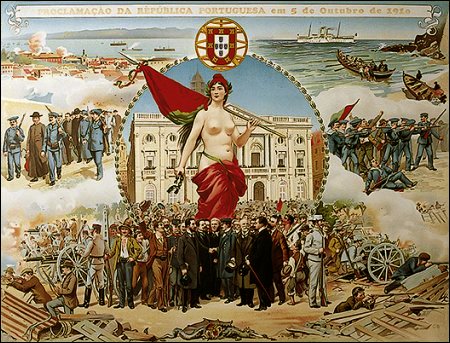 Sunday, October 10, is the 100th anniversary of the establishment of the first republic in Portugal. Relatively short-lived--it died in 1926 with the conservative wave that brought António Salazar to power--it nevertheless is celebrated by many in Portugal today as a first step toward a democratic, progressive state.
There will be events marking the anniversary in Portugal itself and in Portuguese communities around the world. In Montreal, the weekly Portuguese language newspaper A Voz de Portugal is featuring this allegorical picture from the period on its front page, as well as a long story giving the history of the republic on the inside.

The same edition also carries a large ad for another celebration, this one commemorating the appearance of a vision of the Virgin Mary to three children in the poor Portuguese village of Fatima in October 1917. The Republic was militantly laic, authorizing divorce and taking control of much church property, so the vision certainly was a welcome one for forces in the society that wanted a return to strong religious values.
The juxtaposition of the two celebrations in Montreal are evidence of the continuing debate over the place of religion in society. No question where I come down: for separation of church and state. But isn't it an interesting irony that Fatima, that symbol of rock-hard Roman Catholicism, is also a common name among Muslim women? What does that say about cultural crossovers?
Thursday, 7 October 2010
More "Don't Confuse Me with the Facts:" The Link between Prisons for Unreported Crime and Complaints That Never Were Made
More prisons for people who commit crimes that unreported: that's the latest folly from the Harper government. Earlier this week it announced 675 new cells in Kingston and Montreal as part of its crime "clean up" program.
But, according to The Globe and Mail: "The latest Statistics Canada data have the overall crime rate in 2009 down 3 per cent from the year before and 17 per cent from a decade ago. The Crime Severity Index, which measures the seriousness of reported crime, declined 4 per cent in 2009 and stood 22 per cent lower than in 1999."
Oh, that's because people aren't reporting crime as much, Public Safetey Minister Dick Toews said. And, it's true that other Stats Can figures show a decrease in reporting of minor crime over the last 10 years. Yet the figures for major crimes like murder are also declining, and they are unlikely to go unreported.
At the same time, the Harperites are standing firm on abolishing the long form census, and Maxim Bernier is caught out in his fabrication of "thousands of e-mails a day" protesting the census.
The bottom line here is the Stephen Harper and his government don't care about facts. They care about ideology and scaring people--and not just all people, but ones in certain swing ridings--into voting for them
But, according to The Globe and Mail: "The latest Statistics Canada data have the overall crime rate in 2009 down 3 per cent from the year before and 17 per cent from a decade ago. The Crime Severity Index, which measures the seriousness of reported crime, declined 4 per cent in 2009 and stood 22 per cent lower than in 1999."
Oh, that's because people aren't reporting crime as much, Public Safetey Minister Dick Toews said. And, it's true that other Stats Can figures show a decrease in reporting of minor crime over the last 10 years. Yet the figures for major crimes like murder are also declining, and they are unlikely to go unreported.
At the same time, the Harperites are standing firm on abolishing the long form census, and Maxim Bernier is caught out in his fabrication of "thousands of e-mails a day" protesting the census.
The bottom line here is the Stephen Harper and his government don't care about facts. They care about ideology and scaring people--and not just all people, but ones in certain swing ridings--into voting for them
Wednesday, 6 October 2010
Wednesday Wildflowers, Because It's Raining....
But it wasn't yesterday, and the billows of asters that have bloomed this year were stunning.


Tuesday, 5 October 2010
Sad News from Burundi: A Reminder of Bad Old Times Like Something Out of Novel
It's been a couple of montha since I checked to see what was happening in Burundi, the small country on Lake Tanganyika which also has been the scene of much ethnic violence in the last 20 years, although not as much as in its twin Rwanda. The sad news is that things are not going well: 14 bodies were discovered last week north of the capital Bujumbura and several opposition politicians have felt it necessary to flee the country after recent elections.
Nine years ago exactly I spent a short time in Bujumbura to research a novel, The Violets of Usambara. It was a moment when it appeared a power sharing arrangement could be worked out between Hutus and Tutsis. And, indeed, in the years following violence declined and a semblance of order returned. The round of elections this spring and summer appeared to augur well, in fact. But the UN's Integrated Regional Information Network (IRIN) reports that tensions have been high for the last months, even though thousands of Burundians who had taken refuge in Congo are being encouraged to return home, with a similar return of Congolese from Burundi underway.
Sadly, the news this week sounds much like the scenario I painted so long ago. In my story which takes place in 1997, a Canadian politician on a fact-finding mission goes missing outside Bujumbura in an area not far from the border with the Congo. It turns out that he and his driver were killed by persons unknown. What happened recently sound eerily similar. The IRIN story says: "Earlier this week, 14 bodies were discovered in marshes near the Rusizi river, about 10km northwest of the capital, Bujumbura.
“It is difficult to identify them or say where they came from or even whether they are the bodies of Burundians,” Police Director-General Fabien Ndayishimiye told a news conference.
He pointed out that the east of neighbouring Democratic Republic of Congo “is home to the bases of various rebel groups, with skirmishes reported almost daily. Even yesterday we heard gunshots. So far no Burundian has told us about any missing family members. We see bodies but they are not identified.”
The following day, however, the head of a fishermen’s association told reporters four new bodies had been discovered in the river with Burundian identity papers in their pockets. "
How sad that so little has changed.
Nine years ago exactly I spent a short time in Bujumbura to research a novel, The Violets of Usambara. It was a moment when it appeared a power sharing arrangement could be worked out between Hutus and Tutsis. And, indeed, in the years following violence declined and a semblance of order returned. The round of elections this spring and summer appeared to augur well, in fact. But the UN's Integrated Regional Information Network (IRIN) reports that tensions have been high for the last months, even though thousands of Burundians who had taken refuge in Congo are being encouraged to return home, with a similar return of Congolese from Burundi underway.
Sadly, the news this week sounds much like the scenario I painted so long ago. In my story which takes place in 1997, a Canadian politician on a fact-finding mission goes missing outside Bujumbura in an area not far from the border with the Congo. It turns out that he and his driver were killed by persons unknown. What happened recently sound eerily similar. The IRIN story says: "Earlier this week, 14 bodies were discovered in marshes near the Rusizi river, about 10km northwest of the capital, Bujumbura.
“It is difficult to identify them or say where they came from or even whether they are the bodies of Burundians,” Police Director-General Fabien Ndayishimiye told a news conference.
He pointed out that the east of neighbouring Democratic Republic of Congo “is home to the bases of various rebel groups, with skirmishes reported almost daily. Even yesterday we heard gunshots. So far no Burundian has told us about any missing family members. We see bodies but they are not identified.”
The following day, however, the head of a fishermen’s association told reporters four new bodies had been discovered in the river with Burundian identity papers in their pockets. "
How sad that so little has changed.
Monday, 4 October 2010
Anniversaries and Elections: War Measures in Canada, Dictatorship in Brazil 40 Years Later.
 There's an excellent chance that a dissident from anti-dictatorship days in Brazil will become the country's next president. Dilma Rousseff, hand-picked by outgoing president Lula received more votes than any of her opponents in Sunday's elections, but did not get more than the 50 per cent needed to avoid a run-off at the end of the month.
Through an interesting twist of circumstance, the election coincides with the 40th anniversary of what is called here the October Crisis, a period in which a provincial cabinet minister and a British trade representative were kidnapped, and the former killed. The press here is full of stories about what happened then including the declaration of the War Measures Act, which did away with most judicial freedoms including habeas corpus. (Note to NDP: the only MP who protested it was Tommy Douglas, and the party would do well to remember that it's important to take stands on principles.)
Obviously people who are punished for protesting frequently go on to be inspirational figures in a country: Jomo Kenyatta and Vaclav Havel are two that come to mind. Dilma (which is what everyone calls her) probably is not of their stature, but it's encouraging to think that the three years in prison she suffered didn't rule her out of the game, once democracy was finally achieved.
Saturday, 2 October 2010
Saturday Photo: Where Vasco da Gama Set Sail
 Well, actually the Torre de Bélem didn't exist in July 1498 when the great Portuguese explorer left for India. It was built later as part of the fortifications guarding the entrance to the River Tagus and to Lisbon.
 But the Praia das Lagrimas, the Shore of Sorrows, is just steps away. The great Portuguese poet Luís Vaz de Camões memorialized da Gama's departure in his epic The Lusiads, and gave the name to othis stretch of shore where thousands of Portuguese set sail toward an unknown future over a period of several hundred years.
I took the picture when I was in Portugal 18 months ago, and I have beside me on my work table the final proofs of my book Making Waves: The Continuing Portuguese Adventure. My editor Simon Dardick says it will go to the printer next Wednesday, and the first copies will be in my hands in three weeks--ready for another adventure!
Friday, 1 October 2010
Maybe Those Montreal Métro Cars Will Finally Arrive: Why You Should Be Up Front from the Beginning in Calling for Bids
When are we going to get new Métro cars? Reports are that an international call for bids on them has been delayed for a week, while the Société de transports de Montréal and the consortium Bombardier-Alstom negotiate a contract and the provincial government prepares legislation that will remove this transaction from requirements that the bidding process be opened,
The saga goes back four years when things looked ripe for Bombardier to get the whole contract, but Allstom protested in court. The upshot that the French firm was included in the deal which was enlarged, in part because it became clear that more cars were needed. Under existing legislation that meant a larger call for bids, and two other firms, one Chinese and the other Spanish, said they wanted in on the action and went to court to be included.
Four years later, the contracts have not been awarded and things are really mired down. This morning on Radio-Can, the transportation commentator said that the cars--some of which are more than 40 years old--are kept in use because of the skill of STM mechanics who have been masters at coming up with replacement parts.
The proposed special legislation would supposedly open the way to finally going ahead with the award of contracts: the two outsiders who want to bid would not have recourse to international courts because "free trade" treaties are not in effect with their home countries. Had one of them been US based, that would not be the case under NAFTA.
I'm not one to condone sweetheart deals--and the Bombardier bid had elements of that from the beginning--but we need those cars if we are to keep the Métro running. At the moment it's estimated to offer more than a million trips per day, and that figure should be encouraged to increase.
The saga goes back four years when things looked ripe for Bombardier to get the whole contract, but Allstom protested in court. The upshot that the French firm was included in the deal which was enlarged, in part because it became clear that more cars were needed. Under existing legislation that meant a larger call for bids, and two other firms, one Chinese and the other Spanish, said they wanted in on the action and went to court to be included.
Four years later, the contracts have not been awarded and things are really mired down. This morning on Radio-Can, the transportation commentator said that the cars--some of which are more than 40 years old--are kept in use because of the skill of STM mechanics who have been masters at coming up with replacement parts.
The proposed special legislation would supposedly open the way to finally going ahead with the award of contracts: the two outsiders who want to bid would not have recourse to international courts because "free trade" treaties are not in effect with their home countries. Had one of them been US based, that would not be the case under NAFTA.
I'm not one to condone sweetheart deals--and the Bombardier bid had elements of that from the beginning--but we need those cars if we are to keep the Métro running. At the moment it's estimated to offer more than a million trips per day, and that figure should be encouraged to increase.
Subscribe to:
Posts (Atom)