Wednesday, 17 August 2011

Life Goes on Department: The Ducks Did It Again This Summer


As I said earlier, I've been catching up on my usual walks now that we're back in the house. Last year I was delighted to find that ducks had raised a couple of families of ducklings in Parc Pratt, and I wondered if they'd been successful this year.

Yesterday Lee and I saw that they had--not in Parc Pratt, but the fountain in Parc Beaubien had a small flotilla--about 8--paddling around. It was particularly nice to see them as we were on the way to the funeral of a dear friend who died last Friday after an absolutely furious battle with multiple myeloma.

Then this morning I saw a small group of ducks paddling in Parc Outremont, another sign that life does go on...

Tuesday, 16 August 2011

Why Warren Biuffet's Advice Is Good for the Rich Too.

On Sunday friend and neighbor Adrienne Jones handed on this link to a Salon.com article on why it is in the interest of the rich to be taxed more. Basically, the idea is that in societies where inequality is high, the rich don't have it proportionallly better. In fact, they may live in fear, wrote Glenn Greenwald: "If you've visited some rich areas in Latin America, particularly when times generally are bad, marksmen on the roofs of houses are a norm. Living in fear of your physical safety is not a pretty existence.

"Japan, which made a conscious decision to impose the costs of its post bubble hangover on all members of society to preserve stability, has gotten through its lost two decades with remarkable grace. "

Then the next day Warren Buffet asserts in The New York Times that he thinks governments should stop "coddling" the super-rich. "I would leave rates for 99.7 percent of taxpayers unchanged and continue the current 2-percentage-point reduction in the employee contribution to the payroll tax. This cut helps the poor and the middle class, who need every break they can get.

"But for those making more than $1 million — there were 236,883 such households in 2009 — I would raise rates immediately on taxable income in excess of $1 million, including, of course, dividends and capital gains. And for those who make $10 million or more — there were 8,274 in 2009 — I would suggest an additional increase in rate."

The amount of money involved is beyond my comprehension: $1 million a year!

Monday, 15 August 2011

Observation for Today, a Day of Finishing up Odds and Ends

Despite 35 years of metric in Canada, construction is all in the old inches and feet mode, while temperature, speed and some kind of food are metric. What accounts for the difference?

Saturday, 13 August 2011

Saturday PHoto: The Beauties of Mount Royal and the Cemetery

The gates to Mount Royal cemetery don't look like this now. About a year and a half ago fissures were found in the mortar holding the big stone blocks--put in place in the 1860s--together. Since then there have been various steps at correcting the problem. At the moment there is a wooden framework under the arch and straps holding the arch elements in place.

I felt a bit like the gates this morning, as I walked for the first time from the house up to the cemetery. Knees acting up, but spirits bright as I saw the loveliness.


Friday, 12 August 2011

Music and Images: Where the River of Music Can Take You

Back to working on the next novel, called River Music. One of the main characters is a Canadian woman pianist who becomes celebrated, in part because her version of Debussy"s "Girl with the Flacen Hair" is used in one of the rare NFB feature films to win prizes outside Canada.

This is a lovely rendition of the song by an unidentified pianist with a montage by a young Korean Kim dong kyu. Apparentlly this was a graduate exhibition in 2008. Quite lovely.

Some Sounds Only Emerge from Cooperation: Montreal's Musical Swings, a Lesson for Us All?

These musical swings (each one produced a particular tone) were around for a short period this spring, and I had hoped to try them out, but each time I passed they were full of delighted folk.

Let's hope they're put back at some time after the festival season is over. I like the idea of making music cooperatively a lot.

Thursday, 11 August 2011

As We Adjust to Our New/Old House: A Story about a Hobbit's New/Old House

As I ran around trying to find what I've put away while admiring the nice things about our reconstructed house, I came across a story in today's New York Times about a house for Hobbits in Montana. You can rent ilt for $245 a night, if you feel like paying that much to be charmed. Here's the link to a slide show featuring it.

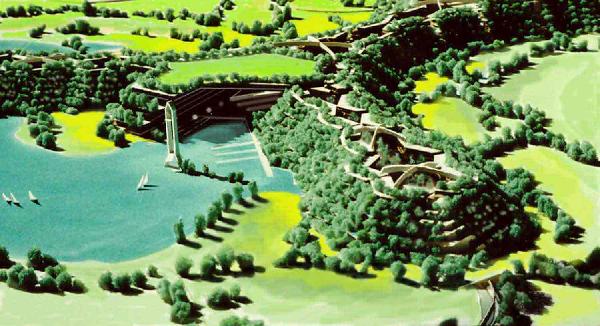
Which reminds me of one of Lee's old friends Gene Zelmer. An architect, he designed and built a number of projects which were wedded to the earth. Here's an example.

But there's a problem with all attempts to build replicas of things described in books. Every reader has his or her own idea of what they looked like, so the new thing is often only a shadow of the vivid image in the reader's head. Something similar is going on in our house: the verdict is that it's the same, but different. Anbd there are moments when I forget the months of disorder.

Wednesday, 10 August 2011

Putting out the Fires in Britain--and Elsewhere--Is Not Going to End Trouble: What Happens When the Social Contract Fails

The pictures of burning buildings in Britain are extremely disturbing, not least because we know first hand how much damage a fire can do. But the question arises: why? It seems too simple to blame it all on hooligans, because even hooligans have a rationale for what they do.

The New York Times talks of "troubled youth", and La Presse carries an Agence France-Presse piece that blames budget cuts for much youthful disaffectation today.

Yesterday The Globe and Mail ran a story by Doug Saunders from London in which he says that Britain has a "'lost generation' of young high-school dropouts far larger than most countries." He adds that one European study found that "17 per cent of Britain’s youth are classified as “NEETs” – for Not in Employment, Education or Training, in other words high-school dropouts with no prospects of employment – the fourth-highest percentage in the European Union. There are 600,000 people under 25 in Britain who have never had a day of work."

This is appalling, and likely is a legacy of the Thatcher cuts of the 1980s that were not redressed sufficiently by the Blair years. One shudders to think what the current wave of cuts in the US and elsewhere will leave behind 15 years from now.

Tuesday, 9 August 2011

Stephen Harper's in Brazil: Dilma Smacks down Standard and Poor

Stephen Harper was in Brazil yesterday, and met with dthat country's former guerilla president Dilma Rousseff. He listened, apparently, while she told reporters about how solide Brazil's economy was and how Standard and Poor's downgrading of the US was "rushed."

Of course, "listened" maybe isn't the proper word because while Harper gets along all right in French, it's doubtful that his Portuguese is all that good. Too bad, because he might learn a lesson or two from this country whish continues to stick, more or less, to the left-centre policies started nearly 10 years ago with the election of Lula.

Here's her interview, for those who want to practice the language of Camões.

Monday, 8 August 2011

The Importance of "Legacy" Media in Telling It How It Is: The Case of The New York Times

"

On of the pleasures of being back in an almost-settled house is that we have more time to intersting things. Friends called yesterday to ask if we'd like to see Page One, the documentary movie about The New York Times, and for the first time in ages we could say, "yes."

The movie was interesting, if somewhat out of focus as it jumped from person to person, worry to worry. But it brought out the importance of having what one of the commentators called "legacy" media to help provide the context, background and analysis essential for making sense of the world. You're not going to get that from Twitter, or the infotainment on many media platforms.

A case in point is Paul Krugman, whose columns in the NYT and blog on its website provide absolutely essential reading. Today he comments on the Standard and Poor's downrating of the US credit status, and once again he's worth quoting. "America’s large budget deficit is, after all, primarily the result of the economic slump that followed the 2008 financial crisis. And S.& P.....played a major role in causing that crisis, by giving AAA ratings to mortgage-backed assets that have since turned into toxic waste.

"Nor did the bad judgment stop there. Notoriously, S.& P. gave Lehman Brothers, whose collapse triggered a global panic, an A rating right up to the month of its demise. And how did the rating agency react after this A-rated firm went bankrupt? By issuing a report denying that it had done anything wrong."

And: "The real question facing America, even in purely fiscal terms, isn’t whether we’ll trim a trillion here or a trillion there from deficits. It is whether the extremists now blocking any kind of responsible policy can be defeated and marginalized."

Saturday, 6 August 2011

Saturday Photo: Fruit Salad for an August Night

First special dinner since we've moved back. Jeanne and her parents, paella and fruit salad with Ontario peaches and BC cherries. What a nice prospect!

Friday, 5 August 2011

More Jobs, Maybe, But the US and the World Are Worrying about the Wrong Things.

Just in case you wondered if things were getting better, here's a link to a breaking story in The New York Times. The job figures for July in the US were better than expected, but did that stop the fall in stock prices? No. After a brief rally, the descent continued.

This is because the people running the show are worrying about the wrong things. As Paul Krugman says this morning: "To turn this disaster around, a lot of people are going to have to admit, to themselves at least, that they’ve been wrong and need to change their priorities, right away.

"Of course, some players won’t change. Republicans won’t stop screaming about the deficit because they weren’t sincere in the first place: ...

"But the policy disaster of the past two years wasn’t just the result of G.O.P. obstructionism, which wouldn’t have been so effective if the policy elite — including at least some senior figures in the Obama administration — hadn’t agreed that deficit reduction, not job creation, should be our main priority. ...

"Well, it’s time for all that to stop. ..It's now time — long past time — to get serious about the real crisis the economy faces. The Fed needs to stop making excuses, while the president needs to come up with real job-creation proposals. And if Republicans block those proposals, he needs to make a Harry Truman-style campaign against the do-nothing G.O.P.

"This might or might not work. But we already know what isn’t working: the economic policy of the past two years — and the millions of Americans who should have jobs, but don’t."

Thursday, 4 August 2011

Excuse Me While I Pause for a Little Rest: the 400 Boxes are Unpacked...

The guy in this video is a piker--on 64 boxes. But we had similar surprises as we opened boxes. Perhaps it should be no surprise that I've filled 8 large garbage bags with stuff from files I've kept forever and ever, but never looked at.

Wednesday, 3 August 2011

Houses, Trips and the Way Ideas for Living Get around

Last week Elin and company spent time in Greater Chicago. She taught at the Viola da Gamba Society of America's annual Conclave, and the rest of the family spent some time exploring the environs.

One of the places they visited was Robie House (1910), Frank Lloyd Wright's visionary private residence now next to the University of Chicago campus in Hyde Park. They came back with a nifty placemat and some coasters in a design from the stained glass in the house.

I was much impressed by the house when I was there researching Chicago for Green City. At the time I didn't appreciate how much the decoration in our house was influenced by trends started by Wright. But the lighting fixture in the dining room (dating from the 1920s probably) definitely show how widely Wright's ideas spread, not to mention the millions of low slung suburban houses of the 20th century which were knock-offs of the Prairie style, like the one on the right in Montreal.

Tuesday, 2 August 2011

Connection with the Universe Re-established, the 400 Plus Boxes are Opened...

but the stuff hasn't been put away yet. The house is nearly as big a mess as the state of the world.

I'll be back with before- and after pix as soon as I can find my camera. In the meantime, I'll continue to sort and wonder why Paul Krugman's and The New York Times' warnings have fallen on such deaf ears in the US.

As Joe Nocera says today about the way the Tea Party gang have done a number on the country and the world: "Never negotiate with terrorists. It only encourages them."

Friday, 29 July 2011

More Than 400 Boxes: Going to Disconnect in Order to Reconnect

There is not likely to be much here over the next few days. The boxes arrived yesterday--something like 450 of them containing about 5,000 books and the various collections of decades in one house--and we're going to spend the next little while sorting things out. With a little luck we'll be back to normal by the first of the week.

In the meantime, wish us luck.

Advice from Paul Krugman That Nycole Turmel and the NDP Should Find Useful

As usual, Paul Krugman today is right on the money. "Republicans have, in effect, taken America hostage," he says. Part of the problem is "the cult of “balance,” the insistence on portraying both parties as equally wrong and equally at fault on any issue, never mind the facts."

Sound familiar, Canadians? Can't let the Harperites get away with it here. As Nycole Turmel said this morning on Radio-Can, as interim leader of the NDP, she's got big shoes to fill while Jack fights his personal battle with cancer. But the country requires a strong opposition, and as a former union leader (among other things) she ought to be able to hold her own in the fights ahead, seconded by an energetic caucus.

Wednesday, 27 July 2011

WalMart Heiress Funds Big New Art Museum

As a sidebar to the previous posting about WalMart advertising on classical music stations, check out the interesting article in The New Yorker about WalMart heiress Alice Walton and her amazing art museum . She's used a large part of her share of the fortune to construct a collection of American art that apparently is unrivalled. It will go into a new Crystal Bridges museum designed by Moshe Safdie in a small Arkansas town of Bentonville.

Safdie also designed Canada's National Gallery (seen on the right) in Ottawa, which some would say is another small town looking for glory.

Advertising and Classical Music: If CBC/Radio-Canada Doesn't Deliver, Private Stations Make Money

We've been listening to the commerical classical music station a lot over the last few months. Partly, it's fatigue--there is so much to do just keeping afloat plus taking care of the house that neither of us has the energy to pick CDs to listen to in the evening. And neither Radio Canada's Espace Musique nor CBC's Radio Two play anything interesting most of the time, sad to say.

As I've posted several times before, this change in programming on the part of Canada's public broadcaster has improved ratings of private classical music stations across the country. (I haven't done the comparisons lately, but once things get back to normal I will.) That success is now showing up in the kinds of advertising the Montreal station is running--lots of concerts and festivals, but also restaurants, Sears, and now Walmart. This last I couldn't believe when I first heard the ad: specials for summer weekends mixed in with a little Mozart.

What does this represent? Several things, I think. First, there is a market for music that is not "popular." Second, that the market covers all parts of society. And third, that CBC/Radio Canada has made some incredibly stupid program choices.

Tuesday, 26 July 2011

Jack Layton: Another Fight for a Man of Courage

Shocked, although maybe not too surprised, to hear that Jack Layton is battling another cancer.

Here's a link to a place where you can send a message of encouragement to Jack Layton, one of Canada's truly good guys. We need him badly.

Monday, 25 July 2011

The Intimacy of Facebook and Men Who Cry in Public on It

Just a quick comment on the day the furniture comes back (the boxes including 5000 books arrive Thursday!): the most emotionally over-the-top posts I've seen on my Facebook network have come from men in the last week or so.

One, who is someone whom I know only because he knows people I know, has been holding forth for the last 10 days about his approaching divorce, how much he misses his kids, how very, VERY unhappy he is. The other, a young man of considerable talent and ambition and whom I have had the pleasure of spending time with, has had some professional reverses lately and was weeping on his page. In his case, it isn't the first time since several months ago when he had a romantic problem, he also unburdened his soul.

Both men received many messages of support from FB friends, far and wide, which I suppose was their aim. If it helped them, terrific. But I can't think of any of my female FB friends who've cried publicly on their pages. Perhaps they have closer, flesh and blood friends to whom they can talk.

Which leads me to some reflection about men and women and their respective emotional networks. Maybe guys find the arms-length "intimacy" of FB easier to handle than actually talking to real people about their problems. And/or maybe this FB semblance of closeness and support is a step in the right direction for men who have always told that it's not manly to show weakness.

Saturday, 23 July 2011

Saturday Photo: Hot Day, Light on Leaves

If you ever wondered about the value of street trees, here's an object lesson. The trees across the street from our temporary digs shade the buildings there, which means they don't receive nearly the same energy from the sun. The leaves are nearly blinding as they reflect back the light and heat.

Our side gets sun from before 7 a.m. until well after noon, and is extremely hot these days.

So glad we have AC at the house, where we are busily getting ready to move back in--and which is shaded by two big old maples.

What Is That Mushroom Cloud Advancing on the City? Just an Amazing Thunderstorm?

This is a link from a friend from the storm we had Thursday night. The view from the terrace here was very similar, and I stood and watched the rising cloud for quite a while, as the lightning flashed. What it reminded me of was the photos of the A bomb tests of my childhood: the same ominous mushroom, the menace of power beyond our control.

I've seen displays like this before, but this one started me thinking about how good it is not to have the Cold War threat to colour our nightmares any more. But as the friend we sent me the link commented, violent weather is a symptom of the harm we're doing in other ways...

Can't give up, the fights are never over... Now to go to work on a morning when the temperature in the apartment is only 28 (75) and the high will bein the low 80s, not 90s.

Video: The Demon Storm from operatique on Vimeo.

Friday, 22 July 2011

A Couple of Laughs on a Hot Day When the Less You Wear the Better (But No Elastic-Breaking, Please)

Got this from a friend this morning. It seems perfect as an antidote for a day that looks blistering:

"In April, Maya Angelou was interviewed by Oprah on her 70+ birthday. Among the things she said was this...

'I've learned that no matter what happens, or how bad it seems today, life does go on, and it will be better tomorrow.'

'I've learned that you can tell a lot about a person by the way he/she handles these three things: a rainy day, lost luggage, and tangled Christmas tree lights.'

'I've learned that regardless of your relationship with your parents, you'll miss them when they're gone from your life.'

'I've learned that making a 'living' is not the same thing as 'making a life.'

'I've learned that life sometimes gives you a second chance..'

'I've learned that you shouldn't go through life with a catcher's mitt on both hands; you need to be able to throw some things back...'

'I've learned that whenever I decide something with an open heart, I usually make the right decision.'

'I've learned that even when I have pains, I don't have to be one.'

'I've learned that every day you should reach out and touch someone. People love a warm hug, or just a friendly pat on the back...'

'I've learned that I still have a lot to learn...'

'I've learned that people will forget what you said, people will forget what you did, but people will never forget how you made them feel.

Please send this to some phenomenal women today. If you do, something good will happen:
You will boost another woman's self-esteem

If you don't....the elastic will break and your underpants will fall down around your ankles! "

Photo: Queen Victoria's drawers, before the days of elastic waistbands. SkyNews
Thursday, 21 July 2011

The True Story of Little Match Girls in Canada: Why Unions and Government Regulation Are Important

"The Little Match Girl" is one of those Hans Christian Andersen stories that wrench the heart: the poor little match seller outside a grand residence dies of cold after slowly burning all the matches she has to sell. It is a staple of sentimental collections of tales for children, and was one of the few stories that made me weep as a child.

Le Devoir ran another about match girls Monday, this one true and even sadder. For decades at the turn of the 20th century, young women worked at the E.B. Eddy match factory in Hull, dipping tiny sticks of wood into phosphorous, a highly toxic substance. Not only did they fall victim to disease specific to handling the substance, but they were frequently victims of fires. Phosphorous was used in matches because it flames at low temperatures, after all, and it seems the match girls had to keep buckets of water by their work stations to put out flames. In the end the factory where they worked burned to the ground because of one such conflagration: a half dozen young women perished because supervisors had padlocked the doors from the outside. In protest, the workers, who had formed the first union of female workers in Canada, walked out on a wild-cat strike.

Today the Boulevard des Allumettières is a major, tree-lined thoroughfare linking one end of Gatineau--the bedroom community across the Ottawa river from the Canada's capital on the Quebec side--to the other. Let us hope these little match girls descendants are able to enjoy some of its benefits. Let us also hope that the horrors of rampant, unrestrained capitalism are not forgotten in this time of union-bashing. Life is not a fairy tale: we need action, not sentiment.

Photo: E. B. Eddy factory and match girls, c. 1880, from Le Devoir.

Wednesday, 20 July 2011

Claire Messud and the Murdochs: A Novel That Saw What Was Coming

One of the few things I've been able to read lately--too much physical labour, it seems, makes you fall asleep at 9:30 p.m.--was Claire Messud's novel The Emperor's Children from 2006. I remember reading a review of it, and thinking it sounded interesting. But I had forgotten the context and I had trouble placing it in time. Thus the ending--which must have been apparent to anyone reading it when it came out--came almost as a surprise for me, and actually increased my pleasure greatly.

The strength of Messud's observations came home this week, when I remembered how she paints a picture of a young Australian media guy, who tries to take the US by storm with a new, bling-filled magazine where the credo is "to shock is to rock." It fails because his timing is terrible--try throwing a launch party on September 13, 2001--and he slopes off to the UK.

Messud has not written a sequel, but I'm sure the guy got a job at The News of the World, and has spent the last several years listening in on conversations there and making or breaking politicos. His name is Ludovic Seeley, but it could have been Tony Coulson or any of a number of others now in the news.

Tuesday, 19 July 2011

Countdown to Moving: Let's Hope It's Not Like This

The clothes, rugs, linens and the like come back on Thursday. Monday it's the furniture, Wednesday the boxes (including 5,000 books.) Maybe it will all be over soon!

BTW, the plumbers fixed the rads, too!

Monday, 18 July 2011

The Nicest Weekend of the Year? Or Why Countries Have Holidays This Time of Year

This was taken as the moon rose on Thursday night, Bastille Day or the Fête nationale française. The moon was not quite full, but the evening was lovely after a hot day.

There followed a weekend where the skies were clear and the moon shone brightly. Too hot during the day, perhaps, but since we were working at the house where the air conditioning is back working, we didn't suffer as much as some people. The evenings, partiularly well after sunset, were very fine for people-watching from the balcon overlooking Mount Royal boulevard, and a breeze sprang up each night which cooled the apartment. It even rained last night, and the heat was broken, at least for several delightful hours.

It is no accident that Quebec (June 24,) Canada (July 1,) the USA (July 4,) and France ( the aforementioned July 14) all have their big national celebrations this time of year. In the Northern Hemisphere, if you're going to have fine weather it will be now, and when the full moon happens to come at the same time, you've got a very fine weekend, indeed.

Given the news of the world (including The News of the World) all of us need a little something--like a full moon--to brighten our collective way.
Saturday, 16 July 2011

Saturday Photo: A Tangle of Hosta Flowers, and Shooting Star Daylilies

One of the joys of a garden full of perennials is that the plants and the flowers come back, even in yars of neglect. I took these yesterday, when the hostas--all descendants of three plants I bought 15 years ago--were in full flower around the front garden patch, and the daylillies were beginning to bloom

Aside from a little watering in recent days and the application (read: dumping) of some composted manure in May, I've done nothing this year to the garden. Still the flowers have come back in their usual progression. Ain't nature grand!

Friday, 15 July 2011

Swimming in the St. Lawrence: Not So Crazy as You Might Think

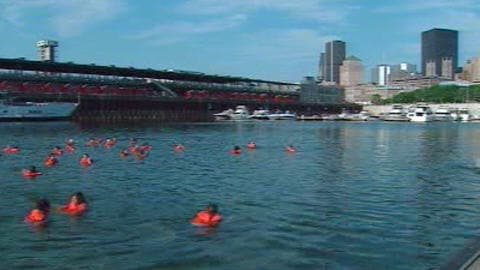
As I write this, at shortly after 7 a.m., some hardy souls are gathering on a pier in Montreal's Old Port, getting ready for the Grand Splash. For the seventh year in a row, the group Montreal Baignade will take the leap to demonstrate that the St. Lawrence River, once so polluted at that point that you could walk in it, is now safe enough to swim in. The members argue that several more access point could and should be developed for public swimming.

The fact that there are four swimming beaches on the island now is a grand step forward. One of my first political actions here was with an anti-pollution group called STOP in the early 1970s, and an early campaign was aimed at getting better sewer treatment. The slogan was "You Can't Swim in the Water You Drink," underscoring the fact that Montreal's water supply is purified river water, but that at that point no beach was deemed safe for swimming.

That's progress, a bit of progress. And certainly with heat and humidity in the forecast for the next several days, it would be great to have more places to swim.

All right: it's approaching 7:45 a.m., the time set for the collective swim. On your marks, get set, GO...

Photo: Last year's Grand Splash, from Radio Canada file
s.

Thursday, 14 July 2011

The Plumbers Came and (Almost) Fixed Things


Well, actually the plumbers yesterday came to put the radiators back in place. They'd been removed so the new hardwood floors could be installed. It only took two guys to take the rads out, but it took three to wrestle them back into place without damaging the floors.

Of course, when the guys went down to the basement to put the system back in business, they ran into problems with the ancient plumbing down there. Had to replace the union joint, which then leaked. So there was another visit yesterday to fix that, but then when the system filled up with water and there was pressure on the rads, one of the newly installed ones started to leak, involving a third visit.

But the problem was still not resolved, and now Lee has gone over to the house to wait for them to come a fourth time. Life can be complicated, post-fire.

Wednesday, 13 July 2011

Upon the Roof: The Place on a Summer Evening

The last couple of weeks on the Plateau, as the house near readiness. It is very hot, and the apartment is hotter, but at least we can get up on the roof.

Reminds me of the old song:
When this old world starts getting me down,
And people are just too much for me to face—
I climb way up to the top of the stairs
And all my cares just drift right into space ...

Tuesday, 12 July 2011

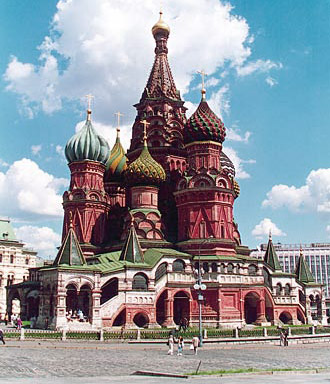
St. Basil's Cathedral and Disneyland: Celebrating Kitsch


Google this morning brings us an image of St. Basil's Cathedral in Moscow (right). Seems it was consecrated on July 12, 1561, or 550 years ago today.

It's quite an impressive construction, but I must admit my first thought was that Google was directing us to Disneyland (left).

I remembered that it opened in July back in the 1950s, and thought Google might be giving the nod to the only theme park that Walt designed and supervised directly. My family visited there a couple of years after the opening (which actually was July 18, 1951) and I remember being absolutely enchanted. All fake, of course, with lots of borrowing from elsewhere.

Certainly there's a huge irony in the resemblance with the old cathedral in Moscow, since Disneyland was conceived at the beginning of the Cold War, during a time when anything Russian was suspect. Maybe Disney thought nobody would notice resemblance, given the black out on information crossing the Iron Curtain. Maybe kitsch is bigger than borders.

Monday, 11 July 2011

The United States: Classless Country of Equality?

One of the strange things about the US (and to a lesser extent Canada) is the way this supposeodly classless society dumps on people who would be considered on the lower end of the class scale elsewhere. Two stories over the weekend in The New York Times point this out.

One, "The Unemployed Somehow Became Invisible," is only the most recent in a series of comments about the way the unemployed have not rallied together to protest what is happened to them. In earlier downturns, "jobless recovery," handouts for the rich, a rhetoric that puts the emphasis on debt reduction, not stimulus, led to serious unrest which led to the social security system among other things.

The other, "Vocational Schools Face Deep Cuts in Federal Funding," talks about the way technical education is being slashed, and the emphasis being put on college education. To be sure, an economy needs high tech workers, but it also needs well-trained, proud tradesmen and women who are not in oversupply.

Something is wrong here. What to do about it?

Friday, 8 July 2011

Saturday Photo: The Eure at Chartres

As the pace quickens in our struggle to get back inot our house, I find myself slipping off mentally into quieter times. This photo is from our trip to France a couple of yeas ago when we wandered around Chartres. A good deal of the time was spent at the cathedral, of course.

But we also enjoyed seeing the other elements in the landscape of this little town where the River Eure provided a means of transport as well as energy long before the glorious cathedral was built. It runs tamely in a canal now, but looking at it gives an idea of how people got around in the past.

Compared to the rivers of North America, the Eure doesn't look like much. Certainly compared to the St. Lawrence it is puny. But sometimes on hot, hurried days like to day, the quieter, calmer river-scape seems most inviting.

Today Too!

Thursday, 7 July 2011

Why There's Nothing Interesting Here Today

Running errands, washing kitchen cabinets, putting out more fires (figuratively speaking) as the countdown on the house continues, so no post today.

Tuesday, 5 July 2011

Coming Up Sometime: A New Short Story Collection

My big news is a nice grant from the Conseil des arts et lettres du Québec to support work on a new short story collection. It'll be called Desire Lines: A Geography of Love. Now all I've got to do is get moved back into the house (end of the July even though things won't be done) and finish River Music, and then I can get to work on it!

Monday, 4 July 2011

Cool City = Low Rent: Better Times for Detroit?

When Montreal seemed to tank after the various crises about French nationalism, some interesting things started to happen, in part because rents were low enough to encourage edgy young people to take chances with art and new businesses.

The same thing seems to be happening in Detroit, according to The New York Times. "These days the word “movement” is often heard to describe the influx of socially aware hipsters and artists now roaming the streets of Detroit. Not unlike Berlin, which was revitalized in the 1990s by young artists migrating there for the cheap studio space, Detroit may have this new generation of what city leaders are calling “creatives” to thank if it comes through its transition from a one-industry."

It's the low rent theory of urban development!

Happy Fourth of July: Is It the Constitution or the Declaration of Independence You Celebrate?

In my Southern California childhood, the Fourth of July was a big holiday, right up there with Thanksgiving, not far behind Christimas. We were taught that it celebrated the birth of the greatest nation on the face of the earth, that the principles behind the founding of the United States of America were truly revolutionary and a model for the world to follow.

Now, having left the US several decades ago, I have considerable distance from the patriotic brouhaha, but I find I'm still marked by it. For example, I am very anti-monarchist and was enraged Saturday night to be hindered from crossing the street by William and Kate's motorcade at the end of the Royals visit to Montreal. I even made a few friends by saying very loudly, "Down with the Monarchy." Lee cringed at my obsteperousness, if not by the sentiment.

The question arises this morning, however: does this holiday commemorate the Declaration of Independence--the model for many revolutionary statements including that of in 1945 by Ho Chi Minh in Vietnam, launching that long, drawn-out struggle out of colonialism--or actual founding of the USA and its far less inflamatory Constitution? I imagine that many celebrations today confuse the two, and the Tea Partiers ignore the difference. The Constitution as it has evolved over the decades, and it is a mistake to take the version written at the end of the 18th century as Gospel, as do the Tea Partiers.

Friday, 1 July 2011

Saturday Photo: Protecting Produce


As we head over to the house early these mornings to see what's happening, we've been going past the community garden at the corner of Henri-Julien and Maguire even before the gardeners get there. This was the scene a couple of weeks ago when a gardener concerned about birds eating seeds he'd sown put up an interesting version of scare crow.

I can report that the seeds seem to have germinated and the garden is considerably lusher. Must take the camera with me one of these mornings to record how well things are growing.

Happy Canada/Moving Day: Maybe a Month from Now We'll Have Moved Too!

In the Rest of Canada, this is the major national holiday, and while there will be some festivities in Quebec, the big thing in Montreal is moving. Most leases run from July 1 to June 30, and since more than half of Montrealers rent, there is a lot running around with trucks, vans and even bicycles. You have to book movers weeks, if not months in advance for the 10 day period around July 1.

And maybe we'll be moved in by August 1. The roof was replaced yesterday, the hardwood floors should be done today, and we have maybe a week of stuff that we have to do. That leaves 1 or 2 days of work that the general contractor has been promising to finish since the end of May. I would like to think that the week after next we'll be able to book movers for the end of the month!

Wednesday, 29 June 2011

Real Bagels Live on in Montreal

Time Magazine is bemoaning the demise of the bagel this week, as one of New York's big bagel bakeries, H&H, goes out of business.

The story by Joshua Ozersky begins: "There are few foods that are truly unique to New York, and the bagel is one of them. Pizza belongs to America now, but the bagel was always the undisputed property of New York, and now it has been diminished." It goes on to protest that making bagels puffy, sandwich buns was the downfall of the bagel, and adds that maybe the closing of H&H is a good thing.

Maybe. I don't know. But I do know that Montreal bagels are not the soft, huge, fluffy kind of thing that Ozersky is writing about. Both the St. Viateur and the Fairmount bagel bakeries turn out chewy, delicious bagels that a better than anything I ever had in New York.

Ozersky ought to come up here to sample them. Maybe he'll learn something about uniqueness.

The photo, BTW, is of the St. Viateur bakery, two blocks from our place. When Lukas was about 3, he spent an hour with a long board, loading blocks in and out of a low cabinet chez nous. When asked what he was doing, he said he was making bagels. You can see what he was thinking about in the photo.


Strawberry Time: Maybe Lee Will Get His Fill, as We Eat Locally

The Jean Talon Market is full of strawberries right now--and I even saw some in a supermarket. The strawberry season is not long here: about a month, except for a couple of varieties that bear all summer.

The weather has been mostly cool, so I don't think the ones I bought were as sweet as they usually are, but while they last we will have them for dessert at night and along side cereal in the morning. In the past it's been worth the trek to the market to get freshly picked berries, direct from a producer. The fact that there were displays elsewhere is a good sign since getting the berries placed in chain groceries has been a problem for producers. Why eat berries trucked across the continent when better ones are just a short haul away?

Health Care Is A Provincial Responsibility Dept: Quebec Drags Its Feet in Going After Medicare Extrabilling, Compared to Ontario

This morning Le Devoir reports that Ontario is going after illegal extra billing for medically necessary services. Last week the McGinty Liberal governments, in pre-electoral mode, announced inquiries into the practice for colonoscopies and cataract treatment, as well as a hot line for complaints about extra billing. This year alone there have been 189 investigations in Ontario, suggesting that charging for everything from valet parking to membership fees is becoming more and more common.

In Quebec, there are 12 on-going investigations, but that doesn't indicate the practice is any less widespread here that in Ontario. Rather, Le Devoir notes, there is no official encouragement to protest extra fees. Patients who pay them may well be too overwhelmed to complain: certainly there is nothing to compare with Ontario's campaign to root out extra billing.

Provinces are responsible for health care in Canada, but the federal government--if it wanted to--could play an important role in stamping out extra billing. It provides part of health care funding and could withhold grants to provinces in the amount of extra billing charged. But do you think that Stephen Harper would go along with that? Not bloody likely.

Tuesday, 28 June 2011

The Up Side of Traffic Snarls: Getting People out of Their Cars

I know, I know, school's out, so there is less traffic on the roads, but the rather speedy amelioration in Montreal's center city traffic snarls these last two weeks is remarkable. There are many, many construction road repair projects under way, festivals which shut down streets for a weekend or a week, plus emergency repairs to bridges which haven't been properly maintained. Voices raised were loud and angry.

Yet this morning walking around the Plateau along streets which had gridlock a few weeks ago when construction forced a detour around a heavily-used intersection, I was amazed at how smoothly traffic was moving. Maybe people have turned to other way to get around, which is what Jane Jacobs and her friends noted when they refused to let cars run through the park in Greenwich Village which Robert Moses and the city of New York wanted 60 years ago. There certainly are more bikes on the road, and in the area affected by bridge repairs, additional trains appear to have become popular.

Of course, discouraging cars is exactly what a lot of European cities are doing. The New York Times has a interesting story on this: "Across Europe, Irking Drivers is Public Policy." And as one blogger notes; "If you're in a traffic jam, you are the traffic jam."

Certainly, Monteal may be doing

Monday, 27 June 2011

Painting Removal and Other Difficult Tasks

Scratching the last bits of paint from the staircase this morning. It is a project begun when we bought the house decades ago, but which stopped about 10 years later. That is the paint has been removed except for those tiny bits that have been left in the cracks--the hardest part. But since this is the time to get this job done at last.

Saturday, 25 June 2011

Rooky MPs Take the Floor: Great Experience in Canada Post Filibuster

There has been a flurry of Facebook posts from the young NDP MPs about the epic struggle being waged in the House of Commons to try to amend the back to work legislation Stephen Harper has proposed to end the Canada Post lock out. Seems that everyone is getting a chance to take the floor!

This is an unintended upside to the filibuster. All those bright young people who ordinarily wouldn't have been given a chance to say much now are carrying the flame. Great experience, even if in the end the Cons can pass whatever they want, given their majority.

Saturday Photo: More Walls Signs, the Good and the Ugly

Walking down lanes and alleys gives you a different perspective on a place, and I've come across some fascinating contrasts on the Plateau. Among them are the carefully painted works of arts which grace some walls and garages. So are the boring and disrespectful graffiti.

This combination from St. Christophe street--just a tiny lane, really--is a striking example of the contrast.

Friday, 24 June 2011

Québec's Fête nationale: No Chasse Galérie This Time, Just Stephen Harper Being Mean

Practically everything is closed in Quebec today, except pharmacies and a few corner stores. St. Jean Baptiste Day, the Fête nationale, is one of the two or three holidays when this province shuts down. There will be parades, open air shows (despite a forecast of rain) and many local parties.

But no MPs from Quebec will be here to join in the festivities because they're all stuck in Ottawa, debating the Harper government's back to work legislation to end the Canada Post lock-out. The bill actually would give less money as a settlement than Canada Post put on the table at the beginning of negotiation.

"Bullies!" was a term heard often last night at a little 5 à 7 reception for people who worked on Thomas Mulcair's very successful re-election campaign. We'd hoped to have the deputy leader of the NDP there to join in the fun, but he, of course, was helping lead the charge against the bill in Ottawa. The whole business is a put-up job on the part of the government--locking out the workers, the provocative back to work terms, the fact that the government refused to suspend the session for the St. Jean, despite the fact that the common practice is to take the holiday into account.

But given the fact that the Cons were nearly wiped out in Quebec in the election, they have nothing to gain by giving a little to win points here. The bill will pass--it is a majority government, after all--but Stephen Harper wants to be as mean as he can....

And, by the way, note that the official poster for this year's celebration features the flying canoe of the Quebec folk tale, the chasse galérie. In it, a bunch of forest workers are stuck at Christmas time in the woods of the Gatineau, and make a pact with the devil to get back to Montreal to celebrate by way of an enchanted canoe. They come to a bad end. Let's hope that doesn't happen this time to the NDP MPs.

Thursday, 23 June 2011

Barbara Kingsolver's La Lacuna and the Story that Follows


The last book discussed at the Atwater book club was Barbara Kingsolver's fascinating La Lacuna. It has haunted my days ever since, so I was delighted to find a New York Times video this week of an interview with a descendant of one of the characters.

She is Nora Volkow, Leon Trotsky's great grandaughter, who grew up in the house where Trotsky was murdered and currently is head of the National Institute on Drug Addiction. Check out the video here.

And to learn about how Kingsolver went about creating the world of Trotsky, Diego Rivera, Frida Kahlo and the fictional Harrison Shepherd, here's an interview with her.


Nora Volkow

Wednesday, 22 June 2011

Bixi Troubles Shouldn't Be Allowed to Make it Pedal Backwards

Montreal's popular bicycle rental program, the Bixi, has been in the news lately for all the wrong reasons. A few weeks ago, the city of Montreal was asked to guarantee $108 million in loans in order to allow the semi-public Bixi agency to expand into other markets. Since then a series of bad news has come out, including yesterday's charges by a former city councillor that the agency has been been badly managed from the beginning.

Sounds rather disturbing. Municipal mismanagement is far too common around here, but I certainly hope the current kerfuffle doesn't lead to Bixi's downfall. Not only is the system used by thousands every day, but its presence seems to have raised the "cool" factor of bike riding in general. This is all to the good when it comes to making a city workable. Getting people on bikes--or on foot--is making a huge difference in reducing traffic snarls at a time when we are paying for decades of inattention to our infrastructure.

Hmm, that makes me think: wouldn't it be simpler to do things right from the first, be it maintain roads, bridges and water systems or set up alternative transit initiatives like Bixi?

Tuesday, 21 June 2011

Summer Solstice on the Plateau

Six months ago, I never thought we'd still be on the Plateau, but now we're at that other solstice and I see a different world than what greeted us when we alighted here after the fire. Here's the view from the terrace, which shows just how green this densely populated neighborhood is.

And here are winter and summer versions of the view across the street. You'd never think you were in the same place.

Monday, 20 June 2011

They Gave Jack a Huge Vote of Conference: Wish I'd Been There

The NDP convention in Vancouver over the weekend has been making headlines. Seems there's was some controversy over whether to talk about a "socialist" or a "social democrat" party, as well as a possible fusion with the Liberals. The first question has been around for as long as I've been involved in the party, or about 30 years. The second is something that's newer, and comes out of the spectacular success of the NDP in the federal election last month.

Boy, I wish I'd been there. Jack the Leader got a 97.9 per cent vote of confidence, which is hardly suprising. The debate about a possible merger was more or less dismissed, it seems, although certainly there are some in the party who think it would be a good idea.

Uniting the Left, the way the current political configuration that is the Conservative Party of Canada united the right about a decade ago, is probably a good thing. But whether it should come by letting the Liberal Party die its own quiet death or by swallowing it up, is a serious question. The NDP has usually stood for more than center-left opportunism that is the hallmark of the Liberals. The NDP has a well-defined party platform--sometimes forgotten when convenient, admittedly--that should be the basis for any discussion of merger and/or coalition.

Two years from now--provided our ongoing house saga is finished by then--I want to be at the convention to help shape the future!

Friday, 17 June 2011

Saturday Photo: A City is a Palimpsest

Once upon a time, the Plateau district of Montreal was on the edge of town, in the country in fact. The house on the left bears witness to that nearly-countrified past. It is now in the heart of the action, but still boasts the graceful galleries that made summer here liveable particularly on the edge of town.

But after the Plateau became the center of the economic action, many houses were built for the workers who lived not far from the places they were employed. Some small manufacturers even provided (for a fee, of course) housing right next to the work place. These houses--now nearly all gentrified--once were homes to people who worked in a nearby bottle factory.

More on Tatoos from a Tatooed Lady, Five Years After

And as I was walking around yesterday, looking at the artfully tatooed arms and shoulders on the young folks here, I remembered that I have two tatoos. They're the marks made to guide the radiation therapy I had nearly five years ago after suspect tissue was excised from my left breast after a diagnosis of ductal carcinoma in situ.

As it happens that operation took place five years ago this week. I'd almost forgotten the timing, which goes to show what happens when everything goes well.

Moral for this morning: routinue mammograms for women over 50 shouldn't be neglected. My DCIS was picked up in just such an exam, and all is well, thank goodness.

Wednesday, 15 June 2011

More Signs of the Times: Tatoos

No pictures so far--it's a bit embarassing to stop people to ask--but I'm struck this year by how many young people now have tatoos. Not just roses or "I love" someone tatoos, but multicolour tendrils, flowers, birds, and mandalas that cover shoulders and arms. The weather has turned nice, and so sun dresses and undershirts are popular apparel, showing off designs that must have cost a fortune to have done. And must have hurt like hell.

A vanity!

Tuesday, 14 June 2011

Time to Make Reading Lists for New Year!

This is the week when I do book discussions, and I've been working on reading lists for the season that will begin in September. Here's a preview:

2011
September
Secret Daughter by Shilpi Somaya Gowda
A runaway best seller about adoption, ethnicity and family love

October
Jane Eyre by Charlotte Bronté
A classic novel that means more with each reading

November
The Wide Sargasso Sea by Jean Rhys
The "back story" of Jane Eyre, told by a master stylist of the 20th century

December
Things Fall Apart by Chinua Achebe
A landmark novel by Africa's most read author

2012

None of the groups meet in January, because January in Montreal is really January

February
The Way to Paradise by Mario Llosa Vargas
A novel about Gauguin and his militant grandmother Flora Tristan by the Nobel winner.

March
The Bridge at San Luis Rey, by Thornton Wilder
An Inca suspension bridge collapses: a novel about destiny by the American novelist and playwright

April
The Postman's Round by Denis Thériault
A short novel about poetry, letter carriers, and love

May
The Sentimentalists by Joanna Skibsrud
Surprise winner of the 2010 Giller prize by the young Montreal writer

June
The Memoirs of Hadrian by Marguerite Yourcenar
The fictional autobiography of a Roman emperor by the French writer

Plus a list of other good reads suggested by book group members:

The Power and the Glory, Graham Greene
Scarlet and Black, Stendahl
Freedom, Jonathan Franzen
The Grapes of Wrath John Steinbeck
The Great Gatsby F. Scott Fitzgeral
Portnoy's Complaint, Phillip Roth
The Long Song, Andrea Levy
The Guernsey Literary and Potato Peel Society by Mary Shaffer
The Empty Family Stories, Colm Toibin
Girl in a Blue Dress, Gaynor Arnold
Black Girl in Paris, Shay Youngblood
Little Bee, Chris Cleave
Changes, Ama Ata Aidoo
A Thousand Splendid Suns and The Kite Runner,
Khaled Hosseini
Trinity by Leon Uris
Chicago by Alaa Al Aswany
Never Let Me Go by Kazuo Ishiguro
American Pastoral by Philip Roth
Mistress of Nothing by Kate Pullinger
On Chesil Beach by Ian McEwan
Family Matters by Rohintin Mistry
Kavalier & Clay by Michael Chabon
A Student of Weather by Elizabeth Hay
The Stonecutters by Jane Urquhart
The Siege by Helen Dunmore
Brick Lane by Monica Ali
Dirt Music by Tim Winton
The Handmaid's Tale by Margaret Atwood
Madame Bovary by Flaubert
Anna Karenina by Tolstoy
Pride and Prejudice by Austen

More Signs of the Times


Monday, 13 June 2011

Going Green in Order to Grow Greenery: The Sweet Potato Experiment

Many, many years ago, my first house plants were sweet potatoes and avocado vines. They were cheap, and satisfied my hunger for greenery. Guess that wouldn't work today!

Saturday, 11 June 2011

Saturday Photo: Signs of the Times on the Plateau

The Plateau district of Montreal was until about 30 years ago a working class neighborhood, full of small houses, neighborhood commerce and light industry. It was scheduled for urban renewal in the 1970s, but was saved, partly by government inertia and partly by Portuguese immigrants who bought and rebuilt the houses through sweat and community financing.

Now it is among the trendiest in Canada. Much of the basic housing/building stock remains but has been transformed. The store at the top--the sign says it's the "Butter Market"= -has been changed to condos: too bad the graffitiers have defaced the sign. The building on the left now houses a theatre troop. The sign is hard to read because of the Virginia creeper which now climbs up the wall: I had meant to take a photo of it before spring advanced too far, but once greenry starts to sprout here it advances very quickly. On the right is a more recent sign in the parking lot--one of the few on Mont Royal boulevard-- of a shoe store/factory.

Thursday, 9 June 2011

Plant Perennials: They Come up Even When You Neglect Them.

There are many varieties of columbine or Aquilegia, as it is known botanically. This lovely flower is a descendant of a couple of plants I bought about ten years ago, and which has naturalized in our small garden.

This spring the joys of perennial plants like columbine have become evident for us. Before our fire Nov. 30, I had more or less put the garden to rest for the winter. Since then I have done nothing, except pull up a few weeds or too-agressive violets. Yet from early spring, flowers have arrived in their usual order, brightening our spirits each time we visit the house and its oh-so-slow rehabilitation. They are sort of a visualization of the idea that hope springs eternal.....

Wednesday, 8 June 2011

The Earth Is Full, and I'm Too Hot (almost) to Care

Today it is hot, heading for the low 30s (the mid 80s F) with humidity that makes the temperatures much more uncomfortable. Last night it was cooler and about 2 a.m. I opened several windows, tryng to fill the place with a reserve of coolness. As I write, that reserve is exhausted and I fell like rag doll.

This is the kind of weather which brings the reality of climate change to mind. Not that it is unusual for Montreal this time of year, but the prospect of lots more than "usual" has been news lately. Is this going to be the pattern for the future?

Looks like it Thomas Friedman says in The New York Times today: "You really do have to wonder whether a few years from now we’ll look back at the first decade of the 21st century — when food prices spiked, energy prices soared, world population surged, tornados plowed through cities, floods and droughts set records, populations were displaced and governments were threatened by the confluence of it all — and ask ourselves: What were we thinking? How did we not panic when the evidence was so obvious that we’d crossed some growth/climate/natural resource/population redlines all at once?"


The Earth is full, and we're living as if we had an extra planet some place where we could get energy, food and other resources, he quotes Australian "environmentalist-entrepreneur" Paul Gilding. What is coming is a "Great Disruption" when we'll have to choose between business as usual and some major changes, based on lives where enough is fine. Friedman quotes Gilding: We are heading for a crisis-driven choice,...We either allow collapse to overtake us or develop a new sustainable economic model. We will choose the latter. We may be slow, but we’re not stupid.”

Glad to hear that. But I must say that this heat decreases my intelligence considerably. Hope it doesn't have that effect on everyone.

Tuesday, 7 June 2011

Even The New York Times Gets Cot--Ulp, Caught--in the Spell Check Trap

Here's the latest from a New York Times feature on the mistakes they make:

A quote about the DSK case:

"While the American justice system has its origins in British common law and involves ordinary citizens at almost every level, the French judicial system is rooted in the Napoleonic Code and is largely conducted behind closed doors. Suspects are typically ushered into courthouses through discrete side entrances, out of view of the public."

The comment:

"The side doors may indeed be “discrete,” meaning “separate.” But we seemed to mean “discreet” — that is, allowing for privacy — and eventually changed it to that."

Glad to see that even the mightiest get caught (cot) not reading for sense (cents).

Here's a classic argument for the need to pay attention to what your writing (righting.)

Monday, 6 June 2011

Four Years of Rants and Reflections but No Eden Recreated...

...but then I didn't expect to do that on June 5, 2007 when started this blog. It was born in a conversation at The Writers' Union of Canada annual general meeting in Vancouver, where I found myself sitting next to Marc Côté of Cormorant Books. He had recently agreed to publish my novel The Violets of Usambara, and during a workshop on the internet and writers, we joked that maybe an African violet blog might be good promotion.

Some 1260 posts and nearly 80,000 visitors later, I'm not sure that it was. A parallel blog on how the book came to be may have done more. But this blog--whose title comes from another book, Recreating Eden: A Natural History of Botanical Gardens-- has become a link with relatively large circle of friends, both old and new. They check in regularly to see what I'm on about this time: that they com back frequently seems to me to be proof that the things I'm concerned about also concern others.

Thanks for stopping by. My friends and family also thank you because your interest relieves some of my insistence about talking about my obsessions! There are times when they just roll their eyes...

Saturday, 4 June 2011

Saturday Photo: What a Difference a Few Months Makes..

This is what it looked like from the terrace yesterday, with Mount Royal covered in green. Below you'll find pix taken from similar points in December and in March.

Friday, 3 June 2011

Roadwork in the Walkable City: Necessary, and Less Trying for Pedestrians than Drivers

Traffic is mess in Montreal these days. Because not enough infrastructure maintenance was done for the last couple of decades, the city and road and bridge authorities are having to do a lot of catch up. At the same time, municipal officials in one center city borough are changing traffic patterns in order to cut down on conflicts between bikes, pedestrians and motor vehicles.

This has caused a storm of protest in some quarters. In the Plateau, where we are living now, residents and merchants clashed at a recent public hearing: residents rather liked the plan to cut down on vehicles, but merchants warned of economic disaster. At the same time, major work is underway on several bridges, and plans are being made to redo a huge traffic interchange.

All this controvesy doesn't concern us, even though we're right in the middle of roadwork. That's because at this point we're walking practically everywhere and taking public transportation when we're not walking. Amazing how efficient living in a walkable city can be....

Thursday, 2 June 2011

Because, Given the Weather Yesterday, We Were All Screaming for Ice Cream


So hot yesterday, so nice and cool today. But given the approach of summer, and the fact that local fruit is still several weeks away, I trotted out a delicious hot weather dessert recently that I thought I'd share, just for fun. It's an adaptation of a pear mousse recipe with a little zing to it.

Pear-Ginger Ice

Four pears (storage ones, like Bosc, work fine)
1 cup of water
3/4 cup of sugar
2 Tb of chopped fresh ginger.
1 envelope of gelatin

Core and cut the pears in dice (no need to peel). Put them, the water, sugar and ginger in a saucepan and cook over medium heat until the pears are cooked through, about 15 minutes. Remove from heat, cool a bit, and blend until smooth.

Dissolve the gelatin in 1/4 cup of water, or whatever the envelope suggests. Stir into the pear-ginger mixture. Pour into a dish that can go in the freezer. Freeze for several hours or over night, removing at least once to stir (you can let the mixture sit on the counter for a half an hour if its too hard to stir) in order to break up the ice crystals. Freeze again.

Delicious! Before you stir after the first freezing step, you can fold in a cup of whipped cream, but I think that doesn't add much.

Photo: Pears last summer on our trees in back: too many for the squirrels to steal completely.

Wednesday, 1 June 2011

The Silver Lining to the Clouds of Disaster: Rebuilding is Like Stimulus Money

The New York Times reports on this probably up side of recent tornados and other disaster in the US this morning, "Reconstruciton Lifts Economy after Diaster." The story says: "There is no silver lining to a funnel cloud, as anyone who survived the tornadoes can attest, but reconstruction can help rebuild local economies as well as neighborhoods."

A little less than 15 years ago, heavy rains and a burst dam led to severe flooding on the Saguenay River, north of the St. Lawence. I remember having supper with friends that July week where there was much tut-tutting about the damage. One guy, however, said, no, the aftermath was going to lift the area out of the slump it was in since reconstruction financed by insurance settlements and government rescue payments would pump in what amounted to "stimulus money." To my surprise, he turned out to be more correct than the doomsayers who said the disaster was the death knell for the towns. I needn't add that he was a Keynes economist who understood the consequences of investment by government.

There are economic historians who argue that Japanese and German prosperity in the 1950s and '60s was in part due to the fact that the two countries had to rebuild their industries and infrastructures, while Britain, for example, struggled on with what had been left over after the war.

Don't know how true that is, but certainly it can be terribly unhealthy to dwell on the down sides of bad things--paralyzing even. However, I must say that even though our house will be freshly painted etc. once the post-fire work is over, I'll be extremely glad to have it done!